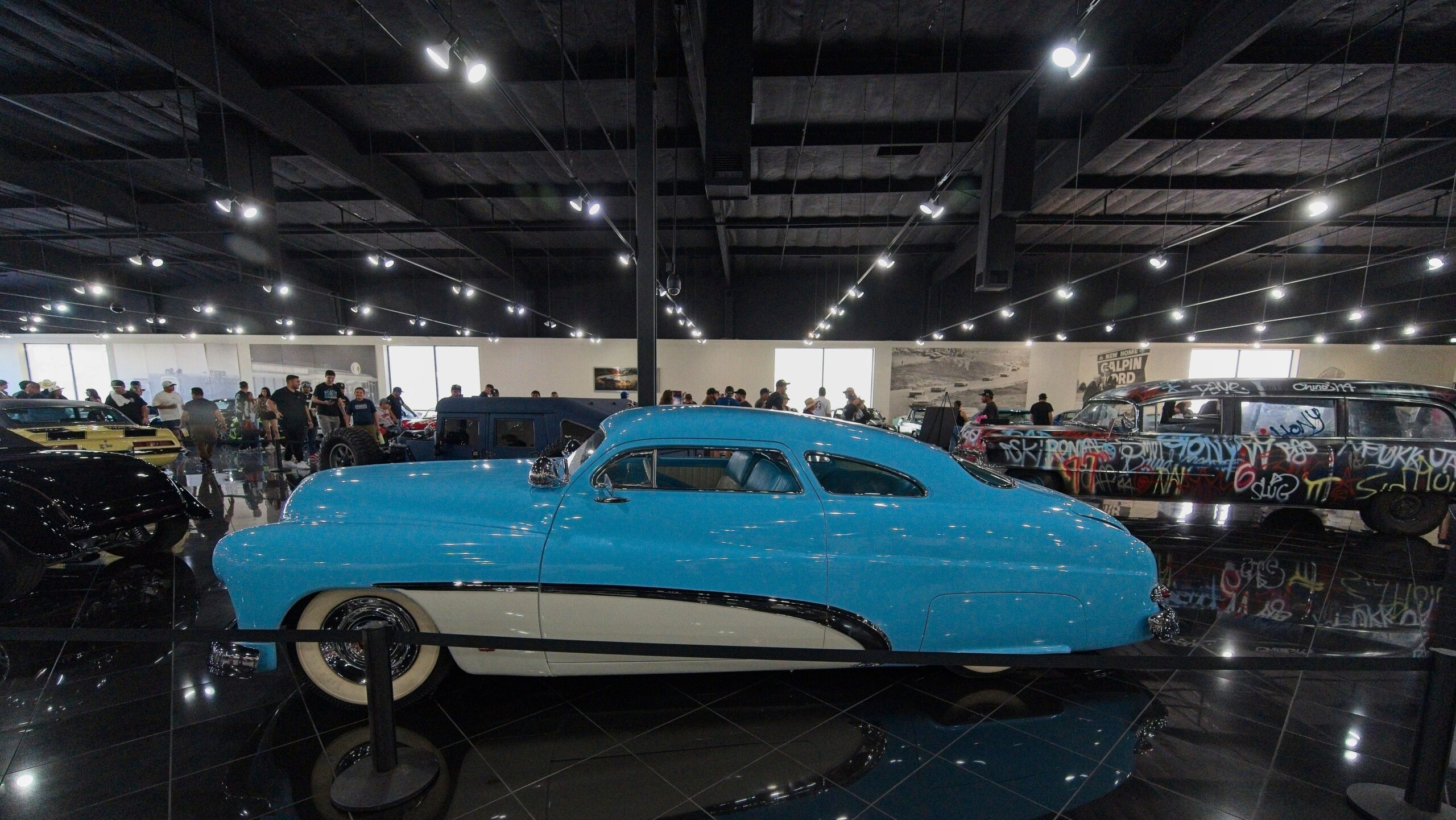
How a young Navy veteran, two visionary brothers, and a 1951 Mercury created the most influential custom car of all time.
Bob Hirohata and a Post-War Vision
The story of the Hirohata Merc begins with Robert Masato “Bob” Hirohata, a young Japanese-American from Southern California whose life was shaped by the turbulence of the World War II era. Bob served in the U.S. Navy during the war and returned home to a nation still adjusting to the aftermath of the conflict and the cultural tensions that followed. Like many Nisei servicemen, he came back determined to reclaim his identity and carve out his own place in post-war America.
Cars became his outlet, a way to express individuality, freedom, and the optimism of a new era. The custom-car movement was exploding across Southern California, and Bob wanted to be part of it in a way that was unmistakably his. He chose the 1951 Mercury Club Coupe as his foundation. By the early 1950s, the Mercury had become the premier canvas for radical customs. Its long, flowing lines and generous proportions made it ideal for chopping, channeling, and reshaping.
Bob didn’t want a mild custom; he wanted something bold, dramatic, and unlike anything else on the road. That desire led him to the most influential customizers in America: the Barris brothers.
The Barris Brothers and the Rise of West Coast Custom Culture
Before the Hirohata Merc ever rolled into their shop, George and Sam Barris had already established themselves as the kings of West Coast custom culture. Growing up in California, the brothers began customizing cars as teenagers, discovering early on that they had a natural talent for reshaping metal and creating dramatic, flowing designs.
They founded Barris Kustoms, which quickly became the epicenter of post-war automotive creativity. Their signature style is longer, lower, smoother, and more elegant than anything coming out of Detroit, setting national trends. Their cars appeared in magazines, car shows, and Hollywood productions, earning them a reputation as the most influential custom builders of the 1950s. It was this reputation that brought Bob Hirohata to their door with a Mercury and a vision.
Creating the Ultimate Lead Sled
With Bob’s trust behind them, George and Sam Barris, along with metal craftsman Frank Sonzogni, set out to create a custom car unlike anything the world had ever seen. What emerged was a masterpiece that would define the entire “lead sled” era. The car featured a dramatic roof chop that created a sleek, fastback-like profile, extended rear fenders, hand-formed skirts that visually stretched the car, and the now-iconic sweeping side trim sourced from a ’52 Buick.
The body was nosed, decked, and shaved for a perfectly clean, uninterrupted surface, and the custom grille crafted from Cadillac components gave the car a distinctive, almost predatory face. Finished in a two-tone green paint scheme that became instantly recognizable, the Hirohata Merc was more than a modified Mercury. It was a rolling sculpture, a statement of style and craftsmanship that set a new standard for custom design.
A Magazine Icon and Cultural Touchstone
The car quickly became a star. It didn’t just appear in magazines; it dominated them. Its presence in early-1950s publications helped define the visual language of custom cars and inspired thousands of builders across the country. It became a symbol of the era: sleek, confident, futuristic, and unmistakably Californian.
Decades later, in 1991, Rod & Custom named it one of the “Twenty Best of All Time,” cementing its place as one of the most influential customs ever built.
Disappearance, Rediscovery, and Preservation
After its show-circuit success, Bob eventually sold the Mercury in the mid-1950s. The exact date is not precisely documented, but it is well-established that the car left his ownership before the end of the decade. Once sold, the car passed quietly into private hands. For a period of time, the Hirohata Merc essentially vanished. It was no longer appearing at shows, and many enthusiasts assumed it had been lost or scrapped.
In the late 1960s, the car resurfaced in Southern California. Despite years of regular use, the core of the Barris craftsmanship remained intact. It was worn, but unmistakably the Hirohata Merc. The most important chapter of the car’s later life began when custom-car enthusiast Jim McNiel purchased the Hirohata Merc in the early 1970s. McNiel immediately recognized its historical significance and committed himself to preserving it.
He restored the car with remarkable authenticity, returning it to its original 1950s Barris configuration, the two-tone green paint, the Buick side trim, the Cadillac grille, the chopped roofline, and the original interior layout. His work was widely praised for its accuracy and restraint. Under McNiel’s care, the Hirohata Merc became a star once again.
It appeared at major custom-car shows, was featured in magazines and books, and became a centerpiece of historical exhibits. McNiel owned the car for over 50 years, becoming its longest and most dedicated caretaker.
A Record-Setting Legacy
After McNiel’s passing, the Hirohata Merc was consigned to auction. In January 2022, it crossed the block at Mecum Kissimmee and sold for $1.95 million, setting a record for a traditional custom car. The sale confirmed what enthusiasts had long believed: the Hirohata Merc is not just a custom car, it is American art.
After the 2022 sale, the car entered another private collection. It continues to appear at high-profile events and remains one of the most photographed and studied customs in existence. Its survival in near-original Barris form is considered one of the great blessings of automotive history.
The Gold Standard of Custom Car Design
The Hirohata Merc represents the moment custom car building became art. It is the blueprint for the lead sled, the symbol of the Barris brothers’ genius, and the car that proved a custom could be more than a hobby; it could be history.
Seventy years later, builders still study its lines, stance, and attitude. It remains the gold standard of custom design, a reminder that when creativity meets craftsmanship, the result can echo across generations.