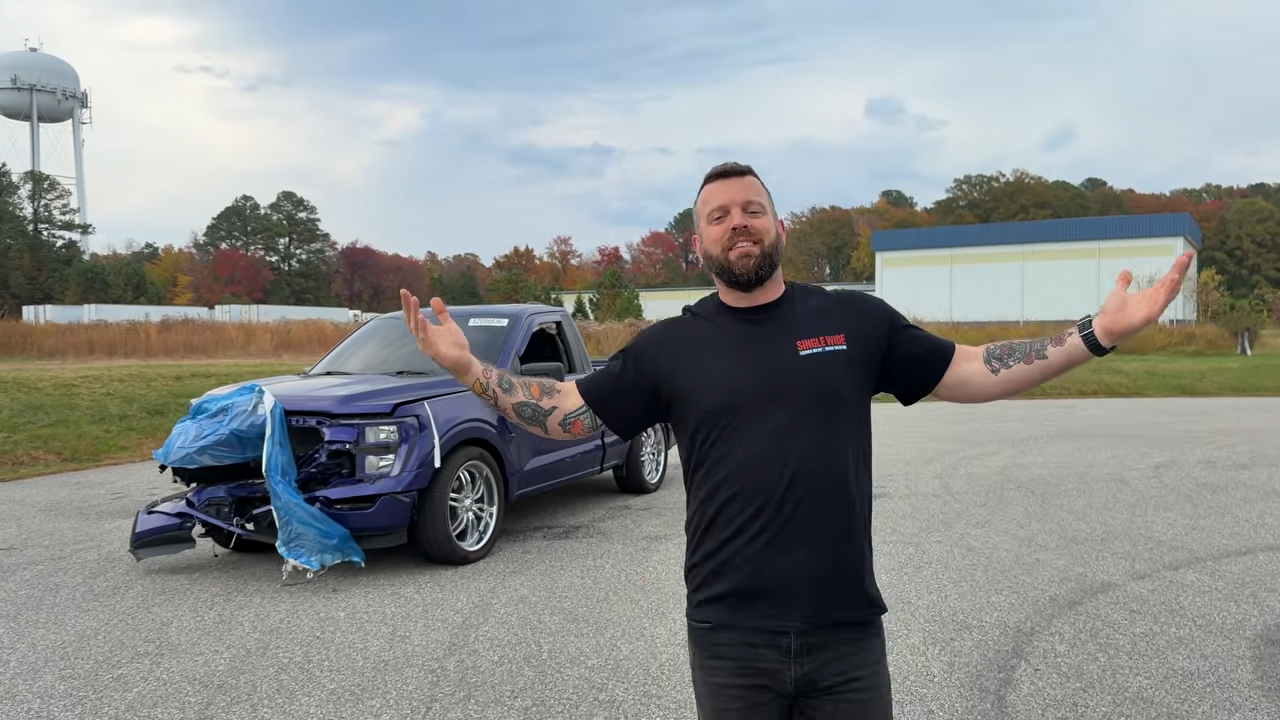
A purple Ford F-150 with a badly crushed front end might not seem like an ideal starting point for a 900-horsepower drag truck. But automotive YouTuber ScrapLifeLee saw something worth saving underneath the wreckage: a running 5.0-liter Coyote V8, four-wheel drive, and a pickup someone had already spent considerable money customizing.
The truck arrived from a California salvage auction with custom purple paint, 22-inch wheels, lowered suspension, and just over 40,000 miles on the odometer. Its engine and radiator had survived the collision, although much of the front structure had been shoved backward. Even moving the truck around presented a problem because it wouldn’t drive straight.
In a new rebuild video, Lee and his crew attempt to bring the F-150 back using parts from another wrecked truck. Their approach involves removing the cab, cutting away damaged frame sections, and using equipment most people wouldn’t associate with precision collision repair.
The result raises an interesting question beyond whether the truck will eventually make 900 horsepower. Ford publishes specific procedures for repairing damaged F-150 frames, and its position on using salvaged structural components is considerably stricter than the approach shown in the video.
More Than Cosmetic
Embedded media follows; please allow a moment to load.
Removing the ruined front-end components exposed substantial damage to both frame rails. One had developed a pronounced kink, while the crash had also displaced mounting points supporting the cab and front bodywork.
With the cab removed, Lee had room to inspect the damage and consider his options. Replacement components from Ford would cost approximately $9,500, according to his estimate. Shopping for used parts might reduce that figure to between $6,500 and $7,000.
Instead, he purchased a second wrecked F-150 for $8,900. Although that truck had significant side damage, much of its front end remained intact. It also had a 5.0-liter engine and 10-speed transmission with approximately 29,000 miles.
Lee estimated that selling the donor truck’s drivetrain could recover around $7,000, with additional money potentially coming from its other usable parts. Those sales had not been completed, but the calculation explains why buying an entire truck made more sense to him than ordering individual components.
A Makeshift Frame Machine
Without a dedicated frame-straightening machine, the crew turned to a forklift and chains to pull the damaged rails closer to their original positions. The process reduced one pronounced bend, although Lee acknowledged that the metal hadn’t returned perfectly to its original shape.
After cutting away the damaged forward sections, they prepared replacement pieces from the donor truck. A tram gauge helped them compare measurements between the two frames before positioning and welding the replacement structure.
The crew also encountered a few awkward surprises. Removing one cab-mount bolt released enough tension that the mounting structure suddenly shifted. Later, after replacing the damaged sections and reinstalling the cab, all six mounting bolts lined up.
Lee considered the collision-related structural work finished, although getting the hood to align properly required replacing a bent hinge.
There is an important distinction between getting the panels and mounting points to line up and establishing that a repaired vehicle meets its original crashworthiness requirements.
Ford’s published 2022 F-150 front-frame repair instructions permit replacement of designated frame sections. However, the procedure calls for anchoring the vehicle to a frame rack and prohibits straightening certain buckled or collapsed sections. It also specifies more extensive replacement when damage extends beyond particular structural points.
Furthermore, Ford’s October 2025 collision-repair position statement says it does not approve joining structures from separate vehicles in what the manufacturer calls a clip repair. Its separate structural-repair statement emphasizes manufacturer-approved procedures and original replacement parts.
The video shows Lee using salvaged structural components from another truck, but without the purple F-150’s confirmed model year and a complete technical inspection, it isn’t possible to establish every applicable repair requirement or independently verify the completed repair’s structural integrity.
The Power Problem
With the front bodywork restored, Lee turned his attention to the reason he wanted the truck in the first place. He had previously dismantled several modified Mustangs, leaving his shop with turbochargers and a ProCharger supercharger system that might work on the F-150’s Coyote V8.
Sharing an engine family, however, doesn’t mean sharing every mounting point.
The Mustang turbo manifolds interfered with components on the truck, including areas near the steering shaft and suspension structure. Reversing their orientation offered another possibility, but would require substantial fabrication.
The ProCharger setup looked more promising. It mounted near the intended location, although differences in the F-150’s timing cover, accessory-drive arrangement, and available space around the cooling fans presented additional challenges.
ProCharger already offers supercharger kits specifically engineered for Coyote-powered F-150s. Lee, however, is attempting to adapt equipment he already owns rather than purchase an entirely new system.
The creator said the ProCharger previously produced 840 horsepower on a dynamometer in another vehicle. That number doesn’t establish what it will produce in the pickup, but it helps explain his preference for the supercharger over the more complicated turbo conversion.
Lee ultimately leaned toward the ProCharger, partly because he hopes to bring the truck to Sick Week in Florida in February. At the end of the video, the supercharger installation remains unfinished, and the repaired F-150 has yet to demonstrate its intended performance on the drag strip.