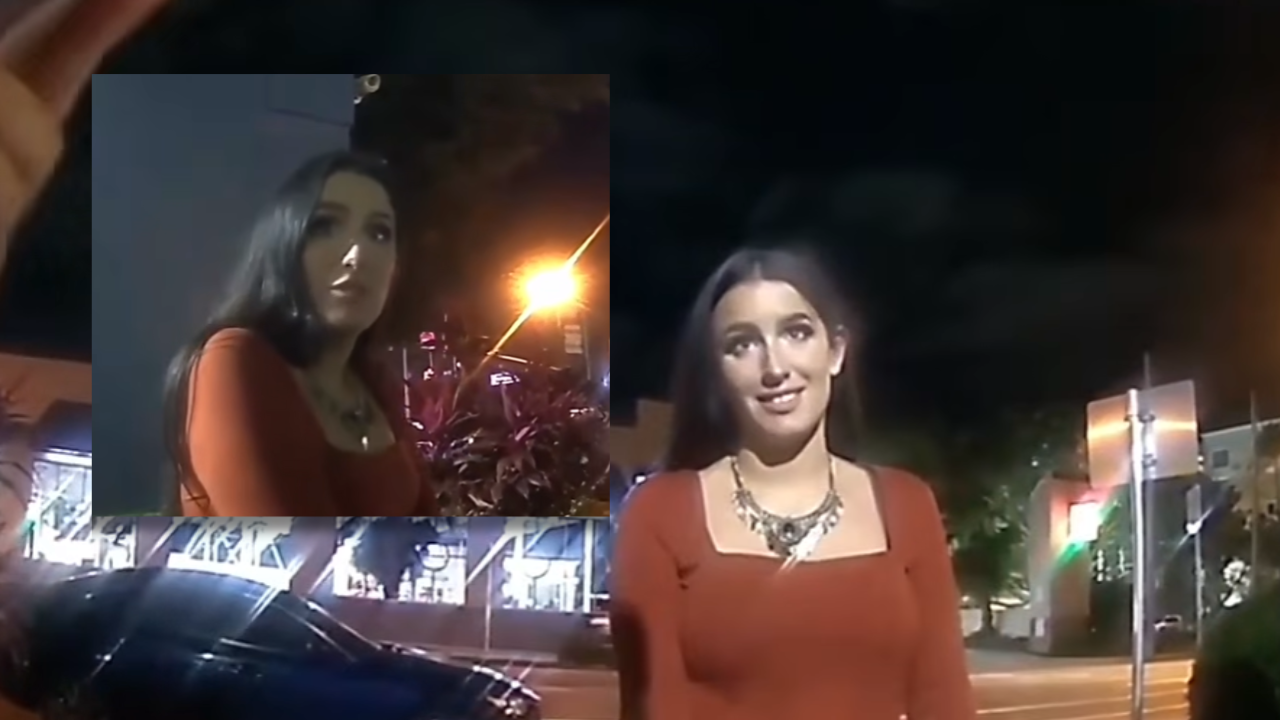
A Florida DUI arrest from December 2020 is getting fresh attention after a YouTube channel published bodycam footage and a legal breakdown nearly six years later. The video follows a woman accused of driving the wrong way through downtown Orlando before a police officer questions her about drinking.
The November 16, 2026, upload from BodyCam Uncovered takes viewers through roadside sobriety exercises, the driver’s statements, and the officer’s decision to arrest her. It even grades both participants and explains the legal rules supposedly governing the encounter.
But the channel’s account has a significant gap. It tells viewers the final outcome of the DUI case was not disclosed, even though Orange County court records show prosecutors resolved the case more than four years before the video appeared.
Those records also reveal what happened to the separate wrong-way-driving citation and how a pretrial diversion agreement changed the criminal case. The findings offer a useful reminder that bodycam footage can document an arrest without telling viewers the whole legal story.
One Wrong Turn
Embedded media follows; please allow a moment to load.
According to the Orlando Police Department’s arrest affidavit, the December 19, 2020, encounter began when Officer Funchess spotted a vehicle traveling north on North Orange Avenue, a street carrying southbound traffic. The driver continued before eventually stopping near East Colonial Drive and North Magnolia Avenue.
Officer Andrew Hall, who handled the DUI investigation, identified the driver as Alexandria Kaitlin Thayer, then 25. In his report, Hall described bloodshot, glassy eyes, slurred speech, and an odor of alcohol.
Hall moved the investigation into a nearby parking lot, away from passing traffic. Before beginning the roadside exercises, he asked Thayer about injuries and whether her footwear might affect her balance. She eventually removed her shoes, with Hall offering his shoulder for support.
The investigation included an eye examination, a walk-and-turn exercise, a one-leg stand, and a test requiring her to estimate the passage of time. Hall documented several indicators he considered consistent with impairment.
After reading Thayer her Miranda rights, Hall questioned her about drinking. According to the affidavit, she acknowledged having two or three vodka Red Bulls and rated her own impairment at four on a scale of one to ten.
One exchange highlighted in the video concerned her estimate of the time. When asked what time it was, she answered approximately 12:12. Hall told her it was 2:45 a.m., a difference of more than two hours.
Hall arrested Thayer for DUI. Later testing paperwork records that she refused a breath test at 3:36 a.m., after receiving Florida’s implied-consent warning. No measured blood-alcohol concentration appears in those records.
Another Way Out
The arrest was only the beginning of a legal process that continued well beyond the night shown on camera.
Thayer entered a written plea of not guilty on December 23, 2020, and was represented by attorney Joel Leppard. Court records show several hearings during 2021, including a defense request for a deposition that Judge Martha C. Adams granted in June.
On August 24, 2021, the court referred Thayer to pretrial diversion and placed the DUI prosecution on hold. That same day, her separate citation for driving the wrong way on a one-way street was dismissed.
Pretrial diversion allows certain eligible defendants to resolve criminal charges through supervised requirements rather than proceeding to trial. It is not the same as an acquittal, but successful participation can result in charges being dropped without a conviction.
Thayer’s agreement called for 15 months of supervision, 50 hours of community service, DUI education, a victim impact class, and six months with an approved ignition interlock device. It also required a $1,000 charitable contribution, fees, and compliance with counseling or testing requirements.
That is considerably more involved than simply paying a traffic ticket. An ignition interlock device, for example, requires a driver to provide a breath sample before starting a vehicle.
The contract warned that violating its terms could result in renewed prosecution. Conversely, meeting the agreement’s requirements would allow the original DUI charge to be dropped.
On September 20, 2022, the State Attorney’s Office filed a document called a *Nolle Prosequi*, formally discontinuing the DUI prosecution. The filing followed the diversion agreement, although the available records do not independently document completion of every individual requirement.
Thayer was not convicted of DUI in that case. The dismissal also did not amount to a court finding that the original arrest was unlawful or that the officer’s observations were false.
The Missing Ending
The newly published video offers more than a recording of the encounter. BodyCam Uncovered presents itself as a legal analysis, citing Florida statutes and Supreme Court decisions while assigning the investigating officer an A-minus and Thayer a C.
Its description also discusses the $164 wrong-way citation and explains how a driver could pay, contest, or otherwise address that ticket. What it does not tell viewers is that the citation was ultimately dismissed.
Under its case-outcome section, the channel says the DUI result was not disclosed. Yet the Orange County Clerk of Courts has records of both proceedings, including the 2021 diversion referral and the prosecutor’s September 2022 dismissal.
The distinction matters because the video combines actual police footage with narration that viewers may interpret as authoritative legal instruction. The footage captures what officers and the driver said during the encounter. The accompanying commentary and case summaries are separate claims that require verification.
The video’s transcript also contains awkward passages and apparent errors in its rendering of spoken material. Those problems should not automatically be attributed to the narrator, since automated transcription and dubbing can introduce mistakes of their own.
The legal citations deserve similar care. A court decision may establish a general rule without resolving every question about a particular traffic stop. Knowing that police can lawfully order a driver out of a vehicle, for example, does not by itself answer whether every subsequent investigative step was justified.
Bodycam channels can offer revealing glimpses of police encounters, and many viewers watch them for entertainment. But footage of an arrest cannot establish a conviction, and a narrator’s legal explanation is no substitute for original statutes and court decisions.
In Thayer’s case, the documentary record supplies an ending absent from the video’s case summary: the wrong-way citation was dismissed on August 24, 2021, and prosecutors dropped the DUI charge on September 20, 2022, following her entry into pretrial diversion.