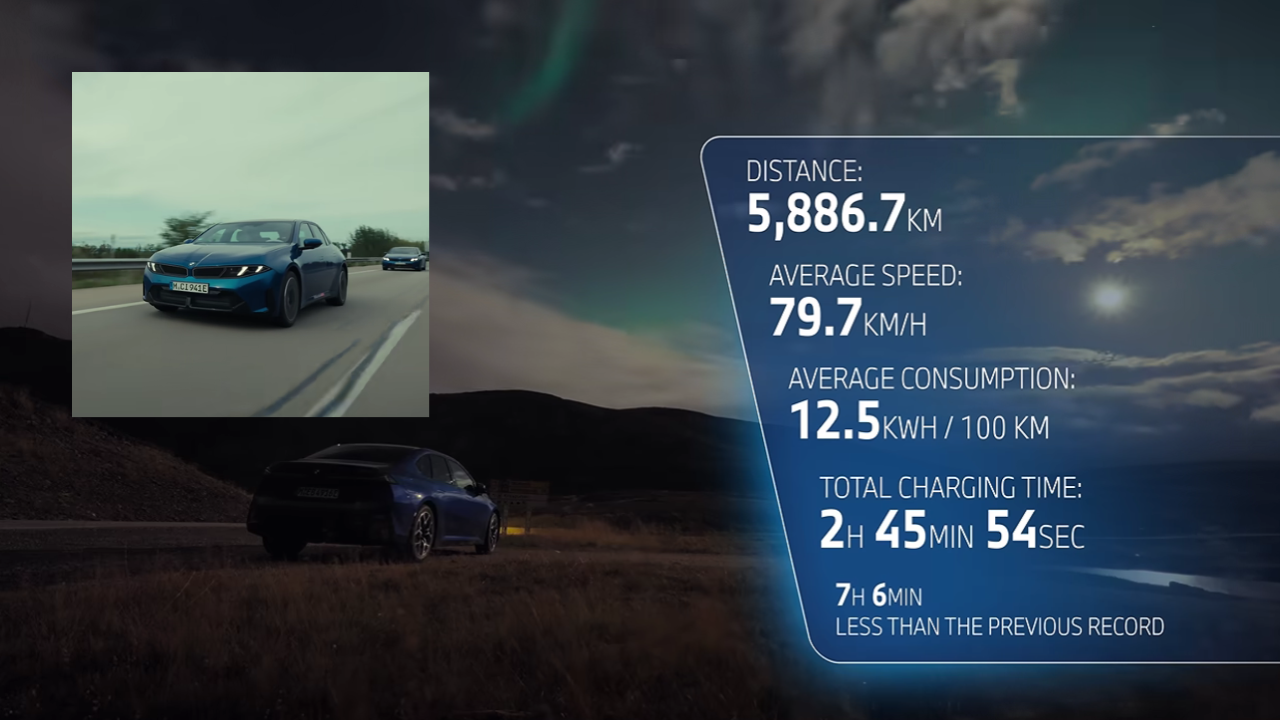
BMW has driven its new electric i3 sedan 3,658 miles across Europe, from the Arctic reaches of Norway to the southern coast of Spain, with less than three hours spent charging. The journey crossed eight countries, and the car managed it using publicly accessible charging stations. That’s quite a test for an electric sedan, especially when long charging stops still worry drivers considering an EV.
The i3 50 xDrive recorded just two hours, 45 minutes, and 54 seconds of charging during the trip. BMW says that beat the previous record for the Paneuropeana challenge, set in 2017, by more than seven hours. It’s a striking improvement in less than a decade, and one that could change how drivers think about taking electric cars on long journeys.
What makes the achievement particularly interesting is that BMW didn’t use a specially modified electric car. The i3 had the same hardware and software specifications intended for customers, and the team relied on public charging stations rather than private equipment unavailable to ordinary drivers.
There is an important distinction between this journey and a family road trip, though. BMW had engineers, support vehicles, and a record to chase. The result is impressive, but the story is a little more than the headline charging time suggests.
Across the Continent
Embedded media follows; please allow a moment to load.
The journey began at Norway’s North Cape, one of Europe’s northernmost points accessible by road, and ended in Tarifa, Spain, overlooking the Strait of Gibraltar. Between those two locations, the driver encountered highways, country roads, and city streets, covering the equivalent of more than six trips between New York City and Chicago.
According to BMW’s November 10 announcement, the drive was part of the Paneuropeana challenge, which Rafael de Mestre established to test how efficiently electric vehicles can travel long distances.
Unlike a conventional race, participants aren’t trying to reach the finish line first. They follow predetermined checkpoints while attempting to spend as little time charging as possible. Teams can choose their own charging locations, allowing them to account for traffic, weather, and the availability of faster stations.
One BMW engineer drove the record-setting i3 throughout the journey, spending 74 hours and 41 minutes behind the wheel at an average speed of approximately 49.5 mph. An identical i3 and an iX3 SUV accompanied the sedan as support vehicles, with BMW confirming that all three matched production specifications.
How BMW Pulled It Off
The i3’s charging performance was only part of the equation. BMW also worked to make the sedan use less electricity while driving, allowing it to travel farther between stops without needing to replenish as much energy.
Across the journey, the car averaged approximately five miles per kWh, an impressive figure for an all-wheel-drive electric sedan. BMW says that was better than the efficiency recorded during its official European testing.
The new i3 uses BMW’s latest generation of electric motors and batteries, designed to improve efficiency and reduce charging times. At a suitably powerful station, BMW claims the car can recover enough energy for approximately 263 miles of driving in just 10 minutes, although actual results depend on conditions.
BMW also paid attention to details that drivers might never notice. The sedan’s body is shaped to reduce wind resistance, while specially designed wheels and tires help it move more efficiently at highway speeds.
The car can also recover some energy when slowing down, returning electricity to the battery instead of wasting it entirely through conventional braking. Together, those improvements helped the i3 make the most of the public charging stations available along the route.
There’s a Catch
As EV Central noted in its November 18 coverage, BMW’s record measures time spent charging, not the total time the vehicle was stopped. Meals, rest breaks, waiting for an available charger, and other delays aren’t necessarily reflected in the headline figure.
BMW also hasn’t published a complete breakdown of its individual charging sessions or the battery’s starting and finishing charge levels. Those missing details make it harder to determine exactly how the engineers managed the journey.
The team had the advantage of selecting charging locations specifically to minimize plugged-in time. An ordinary driver might prefer to stop near a restaurant or hotel rather than travel farther to reach a more powerful charger.
And not every public charging station can deliver the speeds this BMW can handle. A busy or slower station could mean a considerably longer stop, regardless of the car’s capabilities.
That doesn’t take away from the achievement. It does, however, show the difference between a carefully planned record attempt and what most owners should expect during a vacation.
A Different Kind of I3
The record comes as BMW brings back the i3 name for an entirely different vehicle. Unlike the compact electric hatchback that previously carried the badge, the new model is an all-electric version of the familiar 3 Series sedan.
The i3 50 xDrive features all-wheel drive, produces 469 metric horsepower, and can accelerate from 0 to 62 mph in 4.7 seconds. BMW also claims a maximum driving range of approximately 567 miles under European testing standards, although that figure shouldn’t be confused with an EPA rating.
The sedan is built at BMW’s Munich plant, which has undergone major upgrades to accommodate the company’s new generation of electric vehicles.
Mike Reichelt, BMW’s head of Neue Klasse, compact, and midsize vehicles, called the record “a tremendous team achievement” and said it demonstrated the capabilities of BMW’s latest technology.
The result also follows an earlier demonstration in which a BMW iX3 SUV traveled approximately 626 miles from Hungary to Germany on a single charge. This time, the engineers set out to prove something different: how little time a modern electric car could spend plugged in during a journey spanning nearly the entire length of Europe.
The team completed the 3,658-mile route using public charging infrastructure and cut more than seven hours from the previous Paneuropeana charging-time record established in 2017.