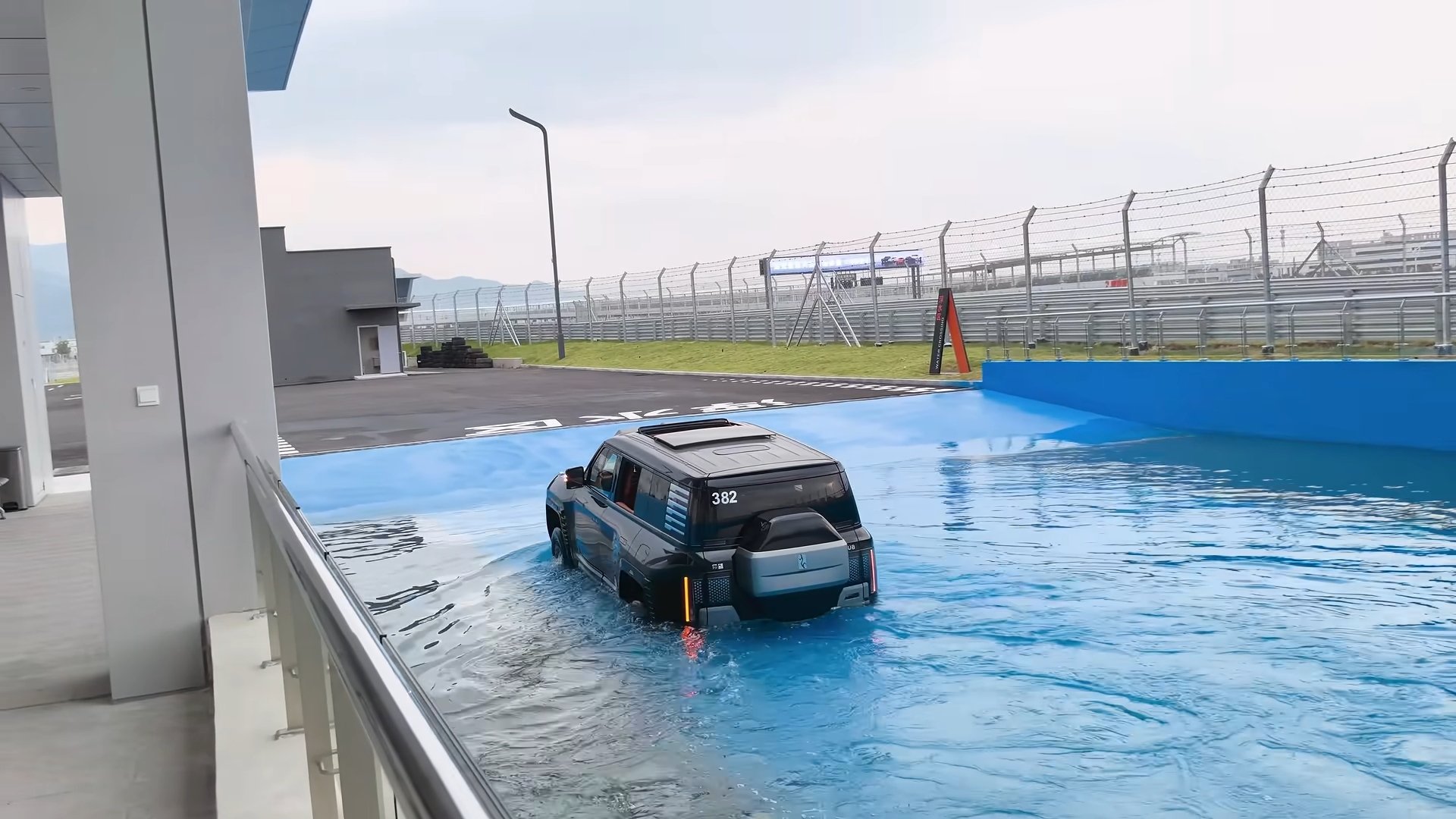
Most luxury SUV rides do not call for a water tank. In Mimi Kuo’s latest tour of Chinese cars, she climbs into a Yangwang U8 as it heads into one, then stays inside while its wheels churn through the water.
Posted November 9, the video on Kuo’s channel takes viewers through showroom visits and driving demos. The U8 gets the most unusual test, though some of the cabin features are just as strange.
Yangwang is BYD’s luxury brand, and Kuo puts the U8’s price above $150,000. Despite the video’s focus on EVs, this SUV is a plug-in hybrid. BYD’s launch announcement confirms that detail.
Kuo also spends time with Huawei’s driving tech and a Xiaomi SUV built around movable seats and sleeping space. Her reactions are often glowing, but sore points turn up once she starts using the features.
Wheels In Water
Embedded media follows; please allow a moment to load.
Inside the tank, the U8’s wheels keep spinning as it moves through the water. Its sunroof opens, which Kuo describes as an emergency safety feature. She says the SUV has already made a U-turn.
Each wheel has its own electric motor. That lets the car change how much power goes to each wheel, giving it a way to steer while afloat.
“I just never imagined a car could do this,” she says. The ride lasts a few minutes before the SUV leaves the tank.
BYD describes the feature as emergency flotation, with up to 30 minutes afloat and low-speed steering. The sealed body and protected drive parts help make that possible; this is a controlled demo of an emergency function.
At another Yangwang event by Shanghai’s Bund, Kuo rides the U8 on a ramp she describes as a 45-degree incline. Going up backward pushes her body forward, while the forward climb leaves her looking toward the sky.
Watch The Road
Huawei’s demo tackles a more familiar chore: getting out of a basement garage. Kuo describes the car leaving its space, passing a barrier, and heading onto the road with driving assistance engaged.
By the return trip, it can head back into the basement and park after the occupants get out. She likes the smooth ride and a display that turns toward her, though she finds the speakers too sharp.
Her trust in the software goes much further. At one point, she says she feels she does not need to watch the road.
Huawei’s own instructions draw a clear limit: its passenger-car system assists the driver. Drivers must stay alert and be ready to take control, even when the car handles steering and parking.
Room Upstairs
In the Xiaomi, Kuo climbs into a roof-level sleeping area with mesh windows and air vents beside the mattress. Moving around makes the space feel shaky to her, and the heat soon sends her back down.
Below, the front seats turn to face the rear seats, making room for a table between them. A sliding center console also clears a path across the front of the cabin. Someone parked close to a wall could leave through the other side.
For sleeping, the cabin changes again as the seats form a broad bed. Kuo finds plenty of room to stretch out, though the road test leaves her less excited: she rates the driving experience as just okay.