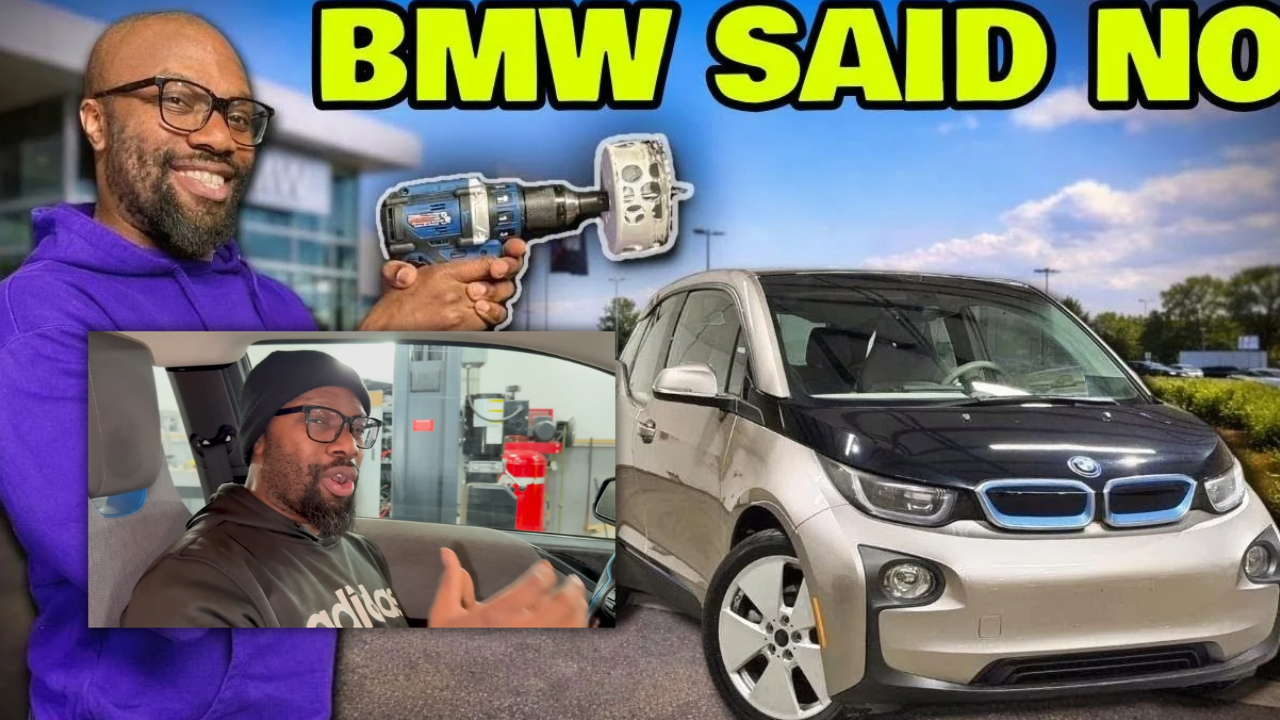
A BMW i3 that once cost around $50,000 ended up selling for just $500 after a dealer decided it wasn’t worth repairing. The electric car had trouble charging, its heater didn’t work, and its small gasoline engine could barely stay running.
Rich Benoit, had already fixed some of those problems. But one stubborn fault remained, and BMW’s repair procedure called for roughly 12 hours of work just to replace a small sensor.
Rather than take apart the drivetrain, Benoit decided to drill through the car to reach the part. He also bought a second broken BMW i3, hoping it could provide anything he needed to get the first one running.
A $5,000 bet with his friend Joey made the job more complicated. Both cars had to run and drive without warning lights within three days. Benoit figured he could beat the clock, but fixing the BMWs proved easier than winning the wager.
The Expensive Sensor
Embedded media follows; please allow a moment to load.
The main problem involved the position sensor on the BMW’s gasoline-powered range extender. This small engine generates electricity to help the i3 travel farther when its battery runs low.
After checking the spark plugs, ignition coils, and fuel system, Benoit still couldn’t get the engine to run properly. Even replacing the old gasoline made no difference.
His scan tool pointed toward a position sensor buried between the engine and the car’s body. BMW’s standard repair procedure required lowering the drivetrain to reach it, adding hours of labor to an otherwise small repair.
Benoit chose another route. In his December 27, 2025 video, he used a hole saw to cut an opening through the i3’s carbon-fiber structure, allowing him to reach the sensor without removing the drivetrain.
The shortcut came with risks. Cutting structural material can cause damage, and the resulting dust can be hazardous to breathe. Still, the opening gave Benoit enough room to remove the old sensor.
Unfortunately, the $30 aftermarket replacement he bought wasn’t quite right. Although it looked almost identical to the original, the connector had a different alignment. After struggling to install it, Benoit ordered the correct BMW part for about $150.
A Second Chance
While waiting for the sensor, Benoit turned to the second i3. The auction paperwork had described it as a nonrunning vehicle, but its body and interior were in surprisingly good condition.
The car initially showed no signs of life. Benoit traced that problem to an aging 12-volt battery, which was nearly seven years old. Connecting a spare battery brought the electronics back online, and the BMW could move under its own power.
A check-engine light remained, however. The scan tool identified a faulty fuel-vapor valve mounted near the small gasoline tank.
Instead of removing the entire tank, Benoit loosened it enough to reach the valve. Testing confirmed that the old part wasn’t working, and a replacement was installed.
The second car was no longer just a source of spare parts. With the faulty valve replaced, it was ready for another test.
BMW’s Strange Design
The project also revealed something Benoit hadn’t expected about the i3’s range-extender engine.
While searching for the cause of its poor running, he examined the engine’s air filter. Unlike the cabin filters that owners can replace during routine maintenance, the engine filter sits inside a sealed housing.
Getting to it required removing panels and working around a rear structural bar. Even after reaching the assembly, Benoit discovered that the filter wasn’t designed to be replaced separately.
The instructional material he watched explained that the entire housing would need replacement if the filter developed a problem. Benoit questioned why such a basic maintenance item had been built into a sealed unit.
Inspection showed that the filter wasn’t badly clogged, so it wasn’t responsible for the engine trouble. The design still drew criticism from viewers, many of whom were surprised that the filter couldn’t be changed on its own.
A Costly Deadline
Once the correct BMW sensor arrived, Benoit installed it through the opening he had drilled. The range extender finally ran smoothly, without the sputtering that had troubled it before.
Both cars passed their driving tests without the warning lights that had threatened the wager. Benoit believed he had won and headed to a Lucid dealership, where he put money toward another electric car.
But Joey had been keeping track of the time.
Although the BMWs were running, Benoit had finished the work more than two hours after the three-day deadline. Joey pointed out that the agreement wasn’t simply to repair both cars. They had to be finished on time.
Benoit had already made a $5,000 payment toward the Lucid when Joey told him he had lost. Under the original agreement, losing meant paying Joey $5,000 and driving cars worth no more than $5,000 for the next six months.
Joey eventually offered him some money to put toward another vehicle, but the six-month restriction remained.
Benoit ended the video facing a very different shopping trip than he had planned. After saving two BMWs that had seemed destined for parts or scrap, he announced that he now needed to find a $100 car.