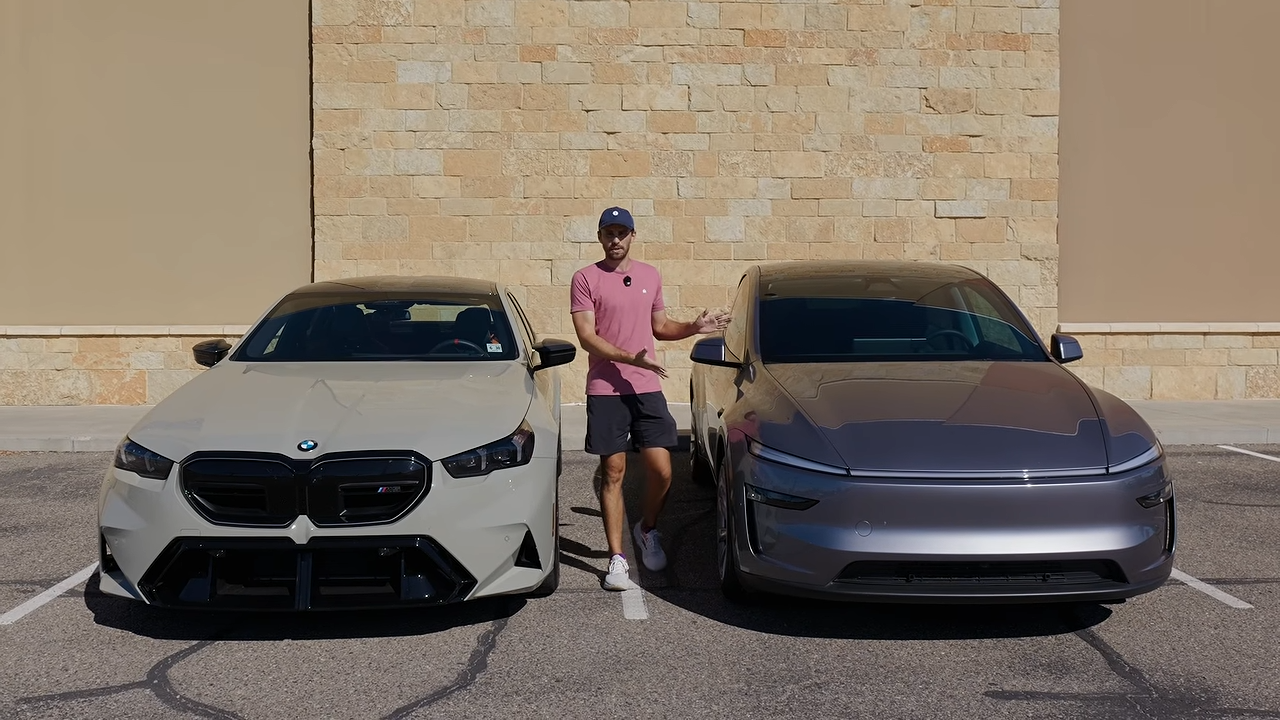
A BMW M5 and a Tesla Model Y have very different reasons for being in someone’s driveway. One is a high-powered luxury sedan, while the other puts much of its appeal into electric driving and software. But when both were asked to handle parking and highway driving, the difference was hard to miss.
YouTuber Gjeebs put his two vehicles through a series of tests to see how their driving assistance systems compare. Both had optional technology meant to take some of the work away from the driver.
He started with something simple: finding an open parking space. From there, he took each vehicle onto public roads to see how well it could handle traffic, steering, and lane changes.
The BMW had no trouble proving that it could park itself. Highway driving was another matter, and the owner’s attempts to get its lane change assistance working became one of the most frustrating parts of the comparison.
A Parking Showdown
Embedded media follows; please allow a moment to load.
The Tesla went first. As Gjeebs drove through the parking lot, available spaces appeared on the Model Y’s screen. He could select the one he wanted, press start, and let the car handle the rest.
After backing into the chosen space, the Tesla had completed its first test without much fuss.
Getting the BMW ready took more effort. Its parking assistant searched for suitable spaces even as Gjeebs drove past several empty ones. Eventually, the system offered him the choice of parking forward or backward.
He selected reverse parking to match the Tesla’s test. While the M5 handled the steering and pedals, he kept his foot near the brake, concerned about nearby curbs. It finished the job without hitting anything.
Although both cars succeeded, Gjeebs felt the Tesla was much faster. He also preferred being able to choose from several visible parking spaces rather than waiting for the BMW to recognize one.
Highway Frustration
Things became more difficult when Gjeebs tried the BMW’s Driving Assistance Professional system on the highway.
The M5 could maintain its distance from traffic and assist with steering, but getting it to change lanes proved difficult. He tried using the turn signal while keeping his hands on the wheel, without getting the response he expected.
Thinking the road might be part of the problem, he moved to Interstate 10 and tried again. The result was much the same.
“I’ve tried it in every possible way and it just doesn’t seem to change lanes,” he said.
The owner acknowledged that his M5 lacked BMW’s more advanced Active Lane Change feature. Still, the car indicated that Lane Change Assistant was available when assisted driving was active.
BMW’s official driver assistance information explains that its systems have different features and operating conditions. The failed attempts in this test do not mean every BMW lacks automated lane changing.
A Different Experience
Switching to the Tesla made the contrast clearer.
Instead of trying to activate individual highway features, Gjeebs entered Arizona Mills as his destination and started Full Self-Driving (Supervised).
The Model Y navigated through the parking lot, recognized a pedestrian, and continued along its route. On the road, it handled lane changes without requiring the driver to steer through each one.
Gjeebs also demonstrated its adjustable driving profiles, which let him change how the car behaves in traffic.
Unlike the BMW’s highway assistance in this test, the Tesla could follow a route toward a selected destination. It was not limited to maintaining speed, distance, and lane position.
Paying for Convenience
Neither system comes without an added cost.
Gjeebs described the BMW’s Driving Assistance Professional package as a $1,700 option, while its $1,850 Executive Package included the parking features he tested.
Tesla takes a different approach. Its Full Self-Driving (Supervised) system costs $99 per month, although Gjeebs said his Launch Edition Model Y came with the software.
Tesla also makes clear that the system requires an attentive driver who can take control at any time. It does not make the car fully autonomous.
By the end of the comparison, Gjeebs was firmly on Tesla’s side when it came to driving assistance. He still enjoyed his BMW, though, and acknowledged that people buy an M5 for reasons other than automated driving.
His experience also wasn’t meant to cover every system BMW offers. The company has more advanced assistance features in other vehicles, which Gjeebs said he hopes to test separately.