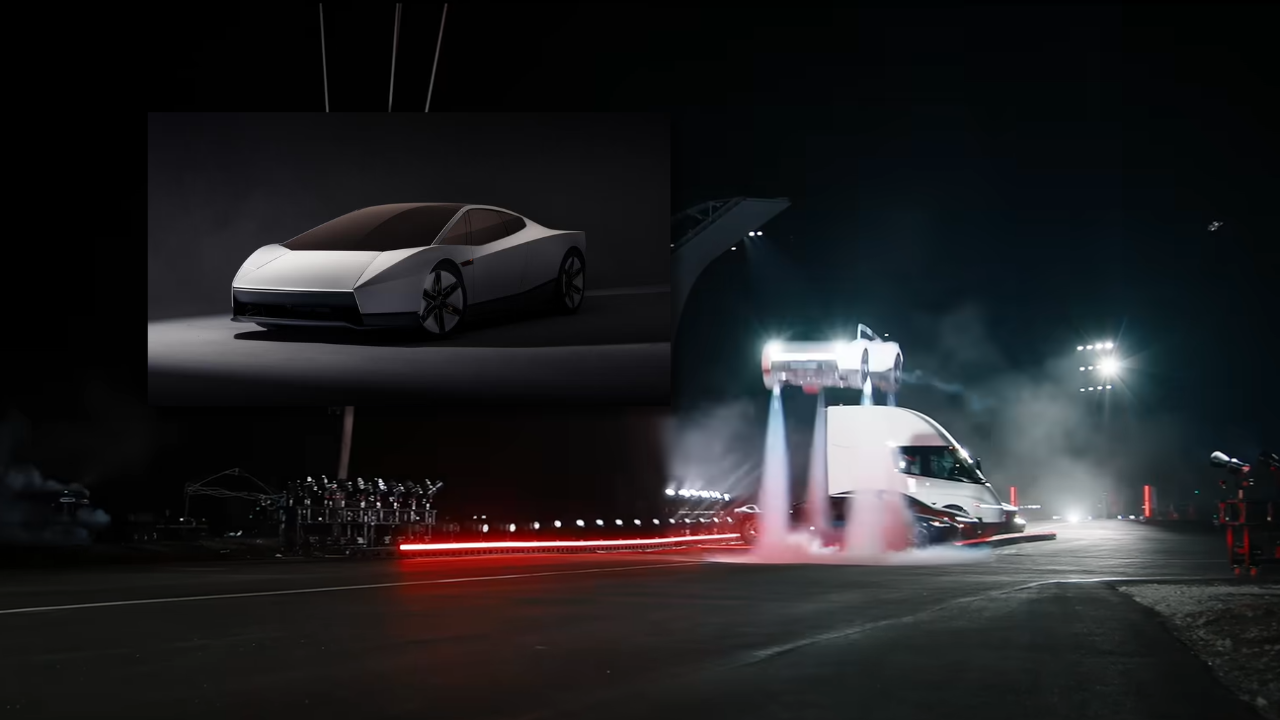
Elon Musk made the Tesla Roadster’s air tanks sound like something an owner could leave to the car. At the reveal, he promised it would “puff itself up” so drivers could repeat its thruster-powered maneuvers.
Their push comes from gas rushing out through nozzles. A full battery alone would not make them ready for another run once that supply was gone.
Engineering Explained doubts Tesla will deliver that feature on the Rocket version. Squeezing gas into the tanks would use up battery charge that the owner could have used to drive.
The Rocket has the largest system to refill. In Hagerty’s walkthrough, the Thrust has a 200-liter nitrogen tank behind the seats. The Rocket adds another 400 liters where the passenger would sit, making it a single-seat car.
Under Pressure
Embedded media follows; please allow a moment to load.
Filling that larger system means squeezing about 550 pounds of gas into the tanks. At an assumed pressure of about 5,250 psi at room temperature, the host needs roughly 35.6 kilowatt-hours (kWh) of energy. That is the minimum, with a perfect compressor doing the work.
A real one gets hot. Cooling the gas takes equipment and energy, while the motor and moving parts have losses of their own. If the car draws in outside air, it also has to filter and dry it. With those demands included, his estimate rises to around 70 kWh or more for a full refill.
A faster pump would shorten the wait. Tesla would then have to fit more gear into a car that has already lost its passenger seat. Even with a perfect pump, a half-hour refill calls for about 70 kilowatts (kW), or 94 horsepower. A real one would need more.
A smaller pump trades that bulk for time. With a 15-kW pump, the host estimates a wait of about five hours. The owner would carry the pump on every drive and hear it running for hours when it was needed.
Plug It In
A strong enough charging supply could run the pump without draining the car’s battery. The refill would then need to fit around a charging stop or a night at home.
On a roughly 10-kW home supply, his 70-kWh refill would take about seven hours. That leaves the owner with an overnight job after brief thruster use. The smaller Thrust system fares better. Under the same assumptions, it needs about a third of the gas and energy.
The host expects owners may end up visiting Tesla for a refill or buying gear to use at home. Either setup would spare the car from carrying a large compressor. Neither would meet the terms of his bet.
He loses if a customer receives a Rocket Roadster that fully refills its tanks while plugged into nothing. If Tesla delivers it, he will pose for a JCPenney photo shoot in Tesla gear and publish the photos.