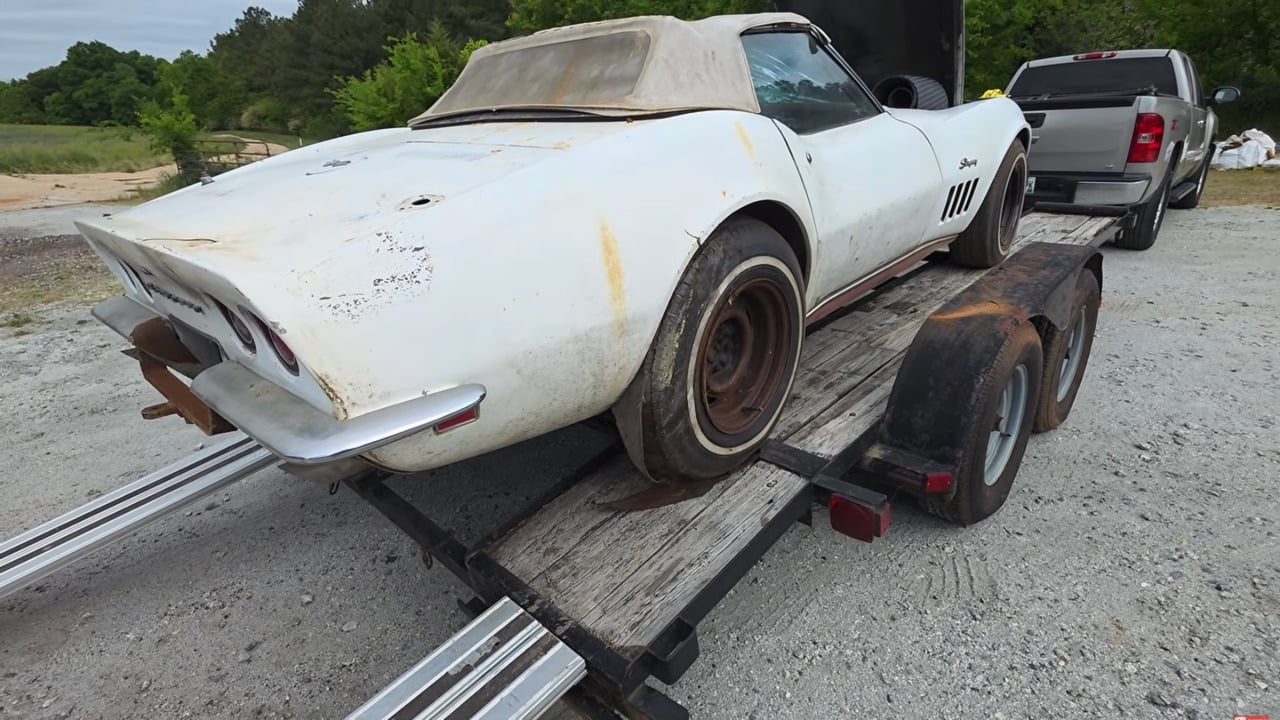
A long-abandoned 1969 Chevrolet Corvette L48 has been rescued from a basement garage after sitting off the road for 36 years, but its attempted return to life has hit a major setback.
The team at Classic Performance purchased the classic sports car for only $3,000, originally making the offer about 18 months before this video. Although the Corvette appeared remarkably original, an initial attempt to get its engine running revealed serious compression problems.
The 1969 Corvette first appeared on their channel after being discovered abandoned in the basement garage of a property sold through a tax sale foreclosure. The team made an offer on the car 18 months ago, but only recently received a call from the owner accepting the original $3,000 proposal.
Despite admitting they didn’t particularly need another project car, the team decided to honor their offer and bring the Corvette home.
Original Details and Fresh Firestone Redlines
With its tires in poor condition, the team carefully winched the car out of storage and loaded it onto a trailer. Once recovered, the team headed straight to the car wash, using tire cleaner, soap, and a pressure washer to remove years of accumulated grease and grime.
One of the first priorities was getting the Corvette rolling properly again. Its existing tires were too deteriorated to hold air, so the team sourced a set of Firestone Super Sport Wide Oval Redline tires through eBay.
The tires were purchased relatively inexpensively and paired with freshly painted wheels, center caps, and trim rings. Although they looked particularly dirty at first, the Redlines cleaned up remarkably well.
The interior also got some attention, and the Corvette’s overall appearance improved considerably after its first clean.
However, the most impressive discovery came under the hood. Despite potentially sitting since 1990, the Corvette retained much of its original equipment, including its numbers-matching alternator, carburetor, intake, and engine block. Even the original AC fuel filter and ignition shielding remained in place.
The last inspection sticker was dated September 1991, suggesting the car had been off the road for about 36 years.
Engine Turns Over, But Compression Causes Major Concern
Before attempting to start the Corvette, the team had already spent around a week soaking the seized engine with Marvel Mystery Oil.
The engine eventually broke free after the car was placed on a steep hill and rolled in fourth gear, using the clutch to gradually turn the motor over. After several attempts, the engine finally rotated, offering hope that the car might be brought back to life without major mechanical work.
With a new battery installed, the engine turned over on the starter. The team then checked the ignition system and initially found no spark, despite receiving 12.68 volts at the coil.
After removing the distributor cap and cleaning the contact points with 600-grit sandpaper and contact cleaner, the ignition system began producing a spark.
Eight new AC Delco R45S spark plugs were installed, and a small amount of fuel was introduced through the carburetor to try to fire the engine.
Unfortunately, the result was little more than a few pops through the carburetor and exhaust. With fuel, air, and ignition seemingly accounted for, attention turned to the engine’s compression.
Just 15-60 PSI Leaves the Corvette’s Future Uncertain
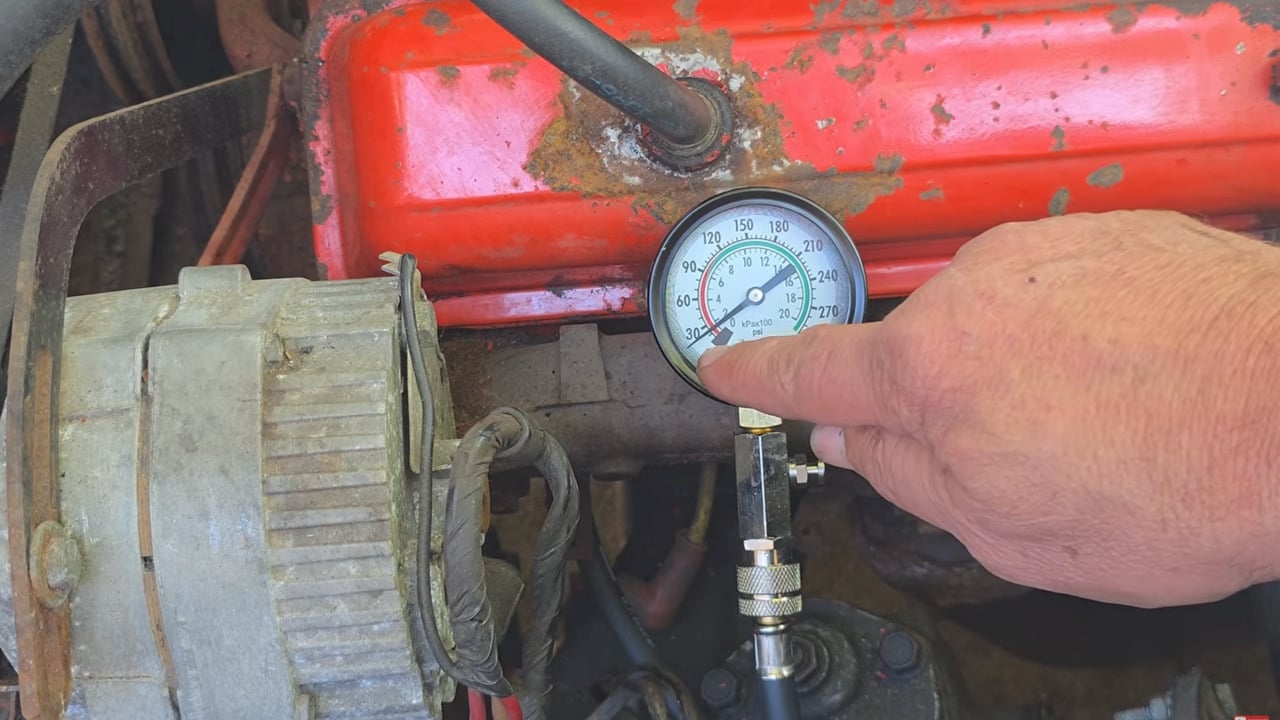
The compression test delivered particularly disappointing results. A healthy L48 350 engine should produce compression readings in the region of 160 PSI, according to factory specifications, making the Corvette’s results particularly concerning.
However, the Corvette’s readings were nowhere close.
The first cylinder produced just 30 PSI (pounds per square inch), while another managed only 10-15 PSI. A third cylinder on the opposite bank reached 60 PSI, even with the throttle held wide open.
Those figures suggest significant internal engine problems, leaving the team questioning whether the motor can be saved without substantial work.
Possible explanations include corrosion inside the cylinders from years of storage, damaged piston rings or a timing chain that has jumped position. The team is considering using a borescope to inspect the cylinder walls and investigate the extent of any internal damage.
Another possibility is that the engine’s timing has shifted, although further investigation is needed before concluding.
Despite the disappointment, the team at Classic Performance has no intention of abandoning the project. The initial plan was to have the Corvette running and driving around the neighborhood after more than three decades in storage, but that target will have to wait.
For now, the team is reassessing its next steps before returning to the 1969 Corvette in a future episode.