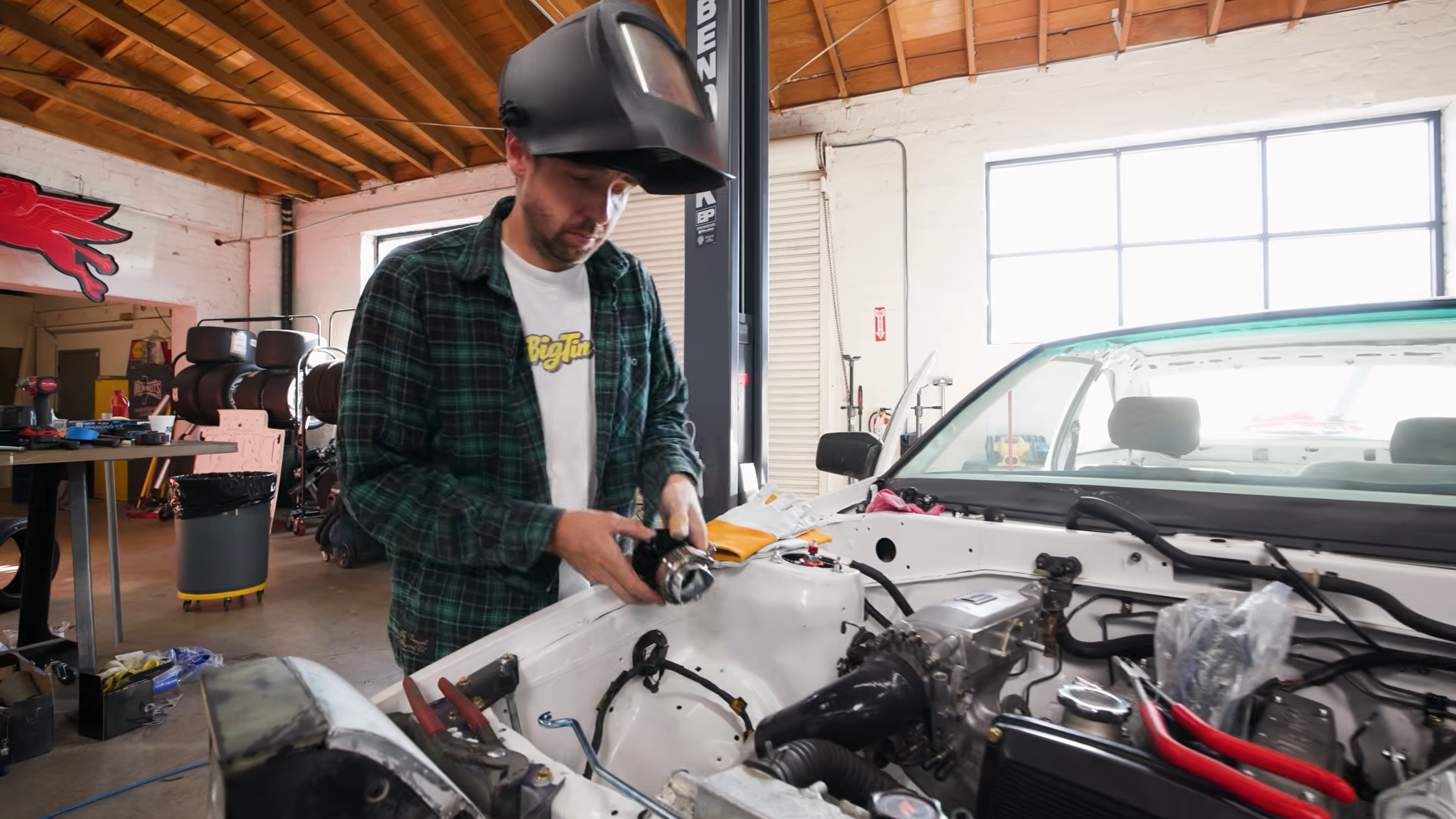
A cheap turbo sounds like a good match for a fake Toyota. In an October 16 episode, BigTime sets out to give its Chinese-made AE86 replica enough power to match the work already done to its chassis.
Under the hood is an original Toyota drivetrain, though the body is a replica. Better brakes and suspension are already in place, but a dyno test put power at about 77 horsepower.
The crew wants to reach 200 horsepower using low-cost turbo parts. With the engine rebuilt and out of the car, they can start fitting the parts that will help it make that jump.
Their budget for the turbo project is $2,500. Getting the hardware into place takes custom work, and this episode ends before the engine runs or returns to the dyno.
A Tight Squeeze
Embedded media follows; please allow a moment to load.
Although the crew keeps calling it a $200 turbo, the final price is $225. They describe it as a copy of a Garrett GT2860, chosen because its small size should suit the engine.
Before bolting it on, they remove the housings and inspect the wheels and machining. It spins freely, and they find no end-to-end movement in the shaft, though that inspection comes before any running test.
A roughly $105 cast exhaust manifold gives the turbo a place to sit. Then the crew has to supply it with oil and coolant, plus a drain that sends used oil back to the engine’s oil pan.
While the engine is still out, Mike adds baffles inside the pan to help keep oil near the pickup during track use. Small rubber flaps let oil move through the baffles toward the pickup.
The pan creates another job when its edge fails to seal evenly against the gasket. Rather than leave a likely leak for later, the crew removes it again and adds sealant.
Once the engine goes back in, the turbo sits close to the brake master cylinder and firewall. Turning its housing buys some space, but the exhaust still needs a tight route past the steering shaft.
Some Assembly Required
Making that route takes several pipe cuts and welds. The new exhaust grows from the stock system’s stated 2-inch size to 2.5 inches, with a clamp that lets the downpipe come off on its own.
Up front, the radiator moves forward to help make room for the intercooler and oil cooler. Cheap charge pipes also need attention, including work on the raised ends that help hold their hose connections.
Even the blowoff valve gets opened up. Its light spring is replaced with a heavier one so the valve stays shut at idle.
With the exhaust close to nearby parts, the crew wraps the downpipe and adds heat shields. Extra insulation goes near the footwell before they tally the spending.
BigTime puts the running total at $1,800, including $810 spent in the prior episode. That leaves $700 for engine controls and fuel upgrades, with startup and the next dyno test still ahead.