A Georgia widow is suing a Ford dealership, an off-road modification shop, and several aftermarket equipment companies, alleging that a six-inch suspension lift on a Ford F-150 turned an otherwise survivable head-on collision into one that killed her husband.
Charles Holloway Jr., 63, died January 8, 2026, after a 2020 Ford F-150 crossed the centerline of Browns Bridge Road in Hall County, Georgia, and struck his 2018 Toyota Tundra. The Ford’s driver, Scott Douglas Kneiss, 61, was subsequently charged with second-degree vehicular homicide, but the wrongful-death lawsuit seeks to establish responsibility beyond the person behind the wheel.
Holloway’s widow alleges that the aftermarket lift raised the Ford’s frame rails and other structural components high enough to bypass the Toyota’s engineered crash protections, allowing the F-150 to penetrate the driver’s compartment rather than engage the structures designed to absorb collision forces. She also contends that the modification interfered with the Ford’s collision-avoidance systems.
Filed June 8 in Gwinnett County State Court, the lawsuit names businesses involved in selling, installing, and manufacturing the suspension equipment, accusing them of contributing to the severity of Holloway’s injuries. One of its legal claims also relies on a Georgia suspension-height restriction that was repealed nearly two years before the fatal collision.
A Fatal Collision and a Six-Inch Suspension Lift
The Hall County Sheriff’s Office’s Accident Investigation Unit reported that Kneiss was traveling eastbound near Ash Circle shortly after 10 a.m. when he crossed into Holloway’s westbound lane, causing the head-on collision that left Holloway dead at the scene.
Kneiss suffered non-life-threatening injuries and was taken to Northeast Georgia Medical Center Gainesville before being booked into the Hall County Jail. In addition to second-degree vehicular homicide, authorities charged him with failure to maintain lane and driving with an expired tag, according to the Sheriff’s Office’s January 9 news release.
After posting $16,960 in bonds, Kneiss was released that evening. His current criminal case status has not been independently confirmed, although the original arrest and charges were also reported by Now Georgia following the Sheriff’s Office’s announcement.
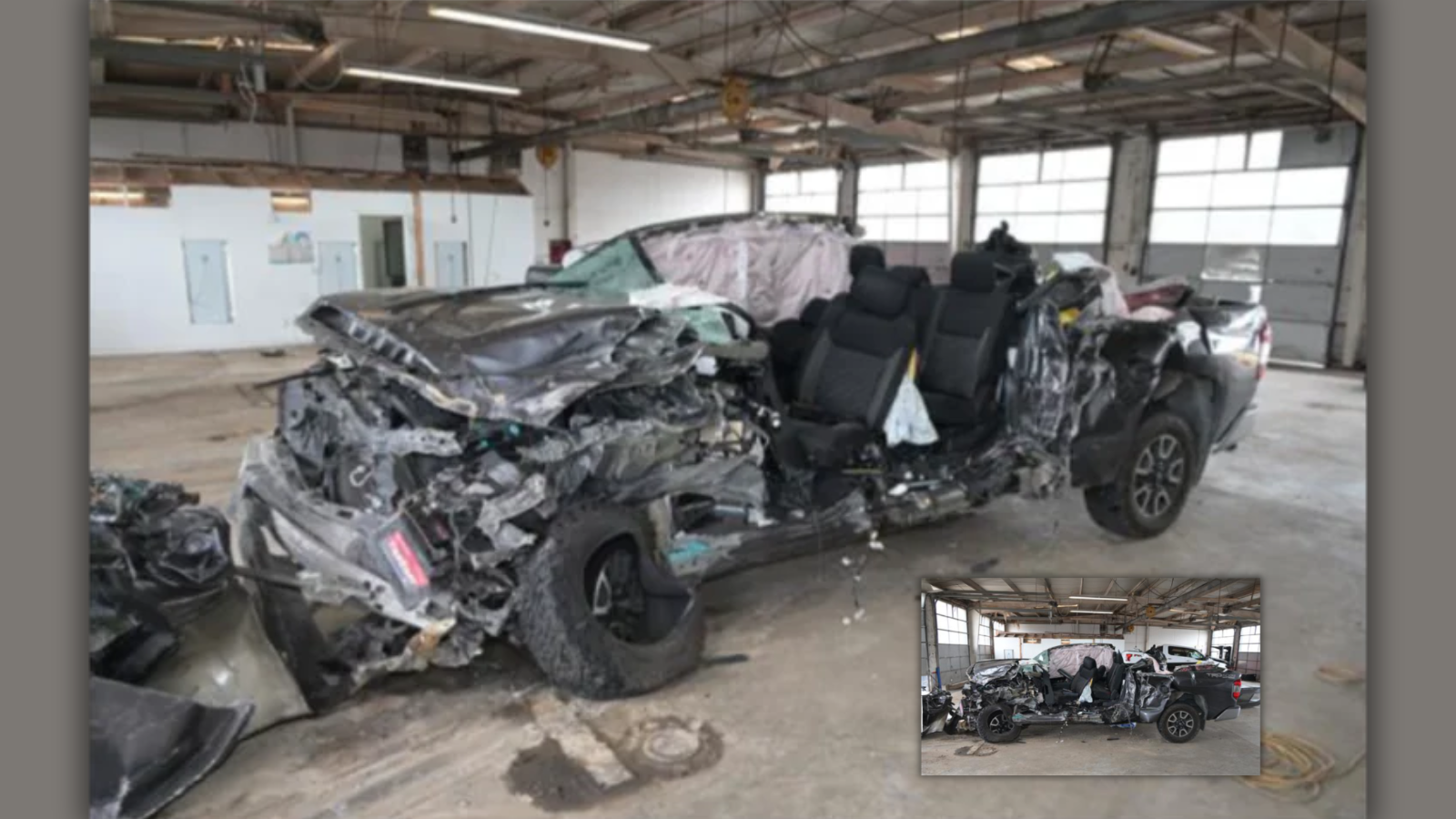
While the original 29-page civil complaint obtained by Guessing Headlights acknowledges that Kneiss caused the collision, it attributes the severity of Holloway’s fatal injuries to the Ford’s modified suspension, alleging that its elevated frame rails passed over the Toyota’s crash-energy management structures instead of engaging them.
The filing includes two photographs showing extensive damage to the Tundra’s front end and cab, although it does not establish when the images were taken relative to emergency extrication or subsequent examination of the wreckage.
Holloway’s widow is pursuing an enhanced-injury claim, a legal theory that allows plaintiffs to seek damages for injuries allegedly worsened by a defective product even when that product did not cause the original accident. In this case, she contends that her husband would not have suffered the same fatal injuries had the Ford retained its factory-designed crash compatibility.
Ford Dealer and Aftermarket Companies Named in the Lawsuit
Courtesy Ford of Rome sold the F-150 to Kneiss, and the original complaint alleges that, before the sale, the dealership caused, authorized, arranged for, approved, integrated, participated in, recommended, incentivized, or suggested installation of the aftermarket lift.
Although that language attributes some involvement to the dealership, it does not establish exactly what Courtesy Ford did or whether the modification was completed before Kneiss purchased the truck or sometime afterward.
GRJ Offroad, a vehicle customization business in Dahlonega, Georgia, is named in connection with the installation, while BDS Suspension, Sport Truck USA, Fox Factory Holding Corp., and RealTruck are identified in connection with the manufacture, marketing, or distribution of aftermarket equipment.
The complaint discusses both BDS and Superlift product lines without identifying a specific lift-kit part number, leaving the precise equipment configuration unclear in the original filing.
The plaintiffs contend that the businesses knew or should have known that substantially raising a pickup’s suspension could compromise its compatibility with other vehicles during a collision. Their allegations include inadequate testing and failures to warn consumers about the possibility of structural override and increased occupant-compartment intrusion, forming the basis of negligence, product-liability, and failure-to-warn claims seeking compensatory and punitive damages.
Several defendants, including Fox Factory, GRJ Offroad, Courtesy Ford, RealTruck, and Kneiss, filed answers during July, with subsequent proceedings involving the substitution of a suspension-company defendant and an amended complaint filed September 8. Those later pleadings have not been independently reviewed for this report.
Crash Compatibility and Structural Alignment
Vehicle manufacturers design frame rails, reinforcements, and energy-absorbing structures to manage the forces generated during collisions, but their effectiveness depends partly on how those components engage with the corresponding structures of another vehicle. When the protective systems are positioned at substantially different heights, one vehicle can potentially override the other, increasing the likelihood that collision forces will reach the passenger compartment.
Research by the Insurance Institute for Highway Safety has examined how differences in vehicle size, weight, and structural alignment influence crash outcomes, particularly in collisions involving passenger cars and larger pickups or SUVs.
A 2008 study published in Accident Analysis & Prevention found that pickups and SUVs meeting improved front-end structural-alignment criteria were associated with a 19% reduction in fatality risk for belted passenger-car drivers involved in front-to-front collisions.
Although that research supports the broader engineering concern raised by the Holloway lawsuit, the January collision involved two full-size pickups rather than a passenger car and a light truck. The study therefore cannot establish whether the six-inch modification caused Holloway’s death, particularly without measurements of the vehicles’ structures or a reconstruction showing how an unmodified F-150 would have performed under the same conditions.
The lawsuit also alleges that the modified suspension degraded the Ford’s collision-avoidance, mitigation, and warning systems, potentially preventing technology designed to help avoid or reduce the severity of a crash from functioning as intended.
Modern driver-assistance systems can depend on precise sensor positioning and calibration, meaning substantial changes to suspension geometry, ride height, or vehicle pitch may require additional adjustments, depending on the equipment installed.
The original complaint, however, does not identify which optional collision-avoidance features were fitted to Kneiss’s F-150, provide diagnostic evidence of a malfunction, or establish whether the vehicle underwent calibration after the lift was installed.
Georgia Rewrote Its Suspension Law in 2024
Among the lawsuit’s allegations is a negligence-per-se claim asserting that the lift-kit defendants violated O.C.G.A. § 40-8-6, a Georgia statute regulating vehicle suspension modifications.
To support that claim, the original complaint quotes a provision prohibiting alterations that raise or lower a private passenger vehicle’s suspension more than two inches from factory recommendations. That restriction, however, was repealed through Senate Bill 352, which took effect July 1, 2024, approximately 18 months before Holloway’s death.
Under the revised statute, suspension-related height restrictions are based on vehicle weight, with an exemption for vehicles equipped with electronic stability control systems complying with Federal Motor Vehicle Safety Standard No. 126.
Because electronic stability control has been required on virtually all new light vehicles since the 2012 model year, Kneiss’s 2020 F-150 would ordinarily have been manufactured with equipment satisfying that federal standard. Whether the truck continued to meet the requirements for Georgia’s statutory exemption after modification has not been independently established.
The original complaint also does not identify when the suspension lift was installed, leaving unresolved whether the modification occurred while Georgia’s former two-inch restriction was still in effect or after lawmakers replaced it.
Even if the truck complied with the applicable vehicle-height regulations, that would not necessarily dispose of the plaintiffs’ separate allegations concerning defective design, inadequate warnings, or enhanced injuries.
The complaint was amended September 8, although it remains unconfirmed whether the revised filing changed the statutory argument presented in June.