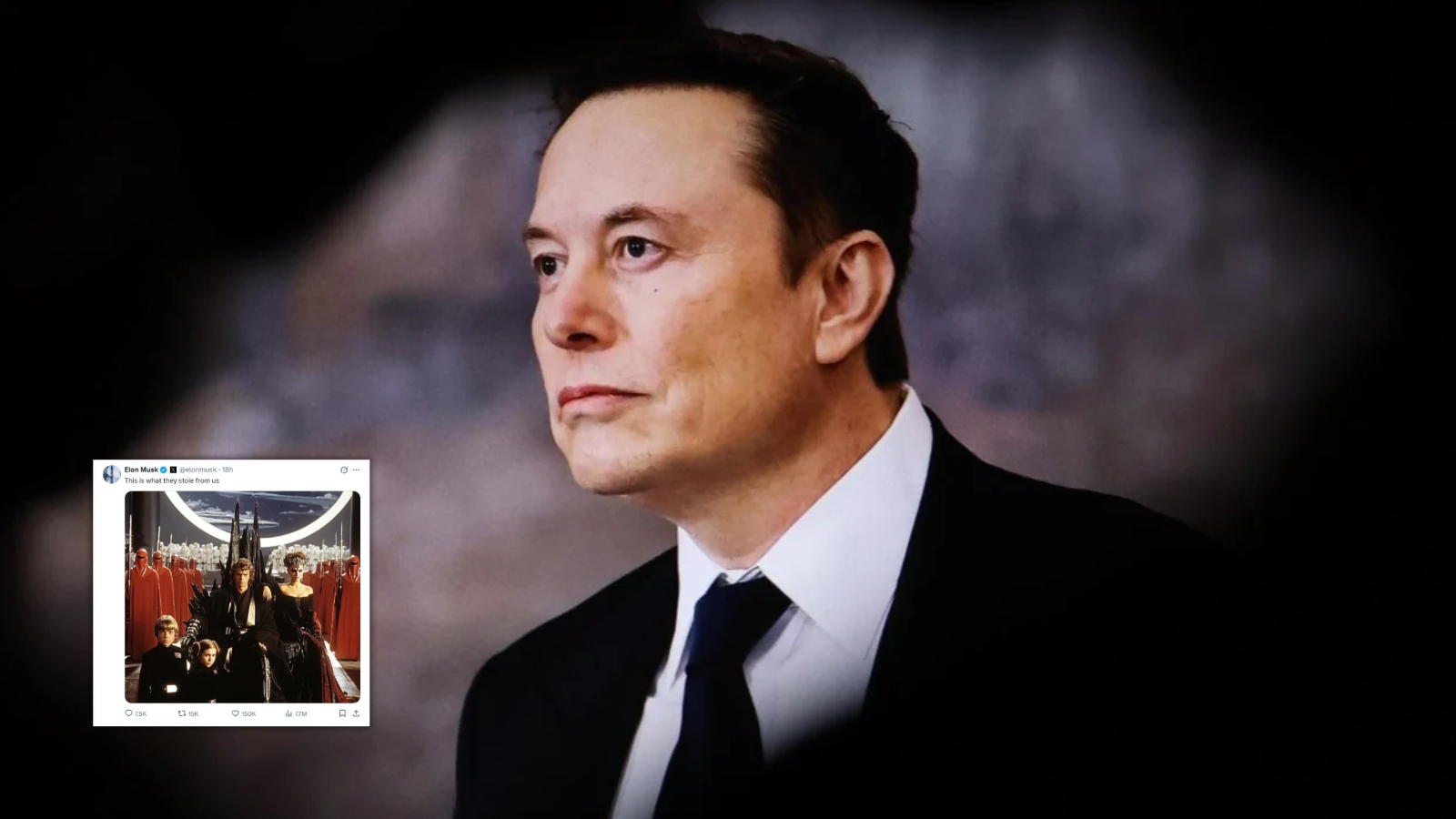
Tesla CEO Elon Musk has stirred up another social media controversy, this time with an alternate ending to Star Wars that puts Darth Vader and his family on the throne of the Galactic Empire. The AI-generated image offers a happier domestic arrangement for one of cinema’s most notorious villains, although not everyone welcomed the imperial family reunion.
Musk shared the image on X on November 1, 2026, with the caption, “This is what they stole from us.” It depicts Anakin Skywalker seated beside Padmé Amidala, with Luke and Leia standing before them. Imperial Royal Guards and stormtroopers complete the portrait, suggesting the Skywalkers have traded their family problems for control of the galaxy.
The post quickly attracted attention. By November 2, ComingSoon reported approximately 5.3 million views, 114,000 likes and 12,000 reposts. Reactions ranged from fans celebrating an alternate ending for Anakin to critics questioning why Musk appeared to admire the Empire.
Musk’s political activities have already complicated Tesla ownership for some customers. Drivers have reported being judged for their vehicles, longtime enthusiasts have distanced themselves from the brand, and researchers have examined how his political involvement has affected sales. His latest Star Wars post has given the argument an unexpected new setting.
A Different Ending for the Skywalkers
This is what they stole from us https://t.co/q1GnpjF394
— Elon Musk (@elonmusk) November 1, 2026
Anakin’s fear of losing Padmé helps drive him toward the dark side, where he becomes Darth Vader under Emperor Palpatine. Padmé dies after giving birth to Luke and Leia, who grow up separately and eventually help bring down the Empire.
Musk’s image gives Anakin his family and an imperial throne. Padmé’s presence is particularly unusual, given her opposition to the authoritarian government that Palpatine established.
Some followers embraced the alternative. One replied, “Anakin deserved so much more!!” Another imagined Anakin listening to Padmé instead of Palpatine. Others suggested Musk should buy Disney and make the ending official.
That prompted a correction from another commenter: Padmé’s death was written into George Lucas’s story in 2005, seven years before Disney purchased Lucasfilm.
The image also drew criticism in a Reddit discussion, where users accused Musk of celebrating an authoritarian government. Lucas drew on Nazi Germany, fascist imagery, and the Vietnam War when developing Star Wars, with the Rebel Alliance fighting against the Empire’s overwhelming military power.
Others questioned the caption itself. One reply to Musk’s post asked, “Who is ‘they’?” Musk offered no explanation, leaving viewers to debate whether the image was a joke about Anakin’s lost family, a fantasy about the villains winning, or another exercise in political provocation.
When Driving a Tesla Becomes a Political Statement
In April 2025, MotorTrend interviewed Tesla owners with different political views about how Musk’s behavior had changed their experiences with the brand.
One couple had supported Tesla since the early Model S days before moving to a Model Y. The husband still appreciated the technology and practicality, while his wife felt uncomfortable driving a car she once associated with environmental progress.
“There’s been a complete shift for what it means to be a Tesla owner,” she told MotorTrend.
Another owner, who voted for Trump in 2020 and 2024 and owned multiple Tesla vehicles and Powerwall systems, admired Musk’s accomplishments but questioned why he would alienate customers through controversial behavior.
Others defended the vehicles. A Model 3 Performance and Cybertruck owner argued that thousands of Tesla employees contribute to the company’s success and should not be judged by the CEO’s politics.
He questioned whether BMW drivers even know their CEO’s political views, much less feel obligated to defend them.
Another Tesla owner described receiving contradictory political insults while driving a friend’s Cybertruck. Strangers had associated him with opposing political movements, although his interest in the vehicles had little to do with politics.
Some owners wanted to sell their cars, but doing so could mean accepting a financial loss. Others continued enjoying their Teslas without wanting to defend Musk.
Even Tesla’s Biggest Fans Have Been Reconsidering
In March 2026, Autoblog reported that some longtime Tesla enthusiasts and online creators were distancing themselves from the company after years of promoting its vehicles through videos, road trips, and technical discussions.
The publication described harassment from opposing political camps, frustration with Musk’s behavior, and dissatisfaction with repeated Full Self-Driving promises that had missed their original timelines. Competition from other EV manufacturers gave owners more alternatives.
The pressures also reached Wall Street. In April 2025, Fox Business reported that Tesla’s first-quarter deliveries fell 13% to 336,681 vehicles. The report cited Musk’s political involvement alongside slowing demand and an aging vehicle lineup.
Wedbush Securities analyst Dan Ives, a longtime Tesla supporter, warned that Musk’s political activities were damaging the brand and urged him to focus more attention on the automaker.
Musk also gained support from political allies. In March 2025, Fox News reported that President Trump pledged to purchase a Tesla in response to boycotts targeting Musk and the company.
For some consumers, buying a Tesla had become an expression of support for Musk. Existing owners could face criticism for vehicles purchased years before his latest political controversies.
The Cost of Musk’s Political Controversies
An October 2025 National Bureau of Economic Research working paper examined Tesla sales against political voting patterns and vehicle registration data.
Researchers estimated that Tesla’s U.S. sales between October 2022 and April 2025 would have been 67% to 83% higher without what they called the “Musk partisan effect,” a modeled difference of approximately 1 million to 1.26 million vehicles.
Separate S&P Global Mobility data, reported by Reuters, showed Tesla’s U.S. household brand loyalty declining from 73% in June 2024 to 49.9% in March 2025, before recovering to 57.4% in May.
Tesla also faced stronger competition, changing EV incentives, and criticism of its product lineup. In January 2026, Car and Driver reported that BYD had overtaken Tesla in worldwide battery-electric vehicle sales.