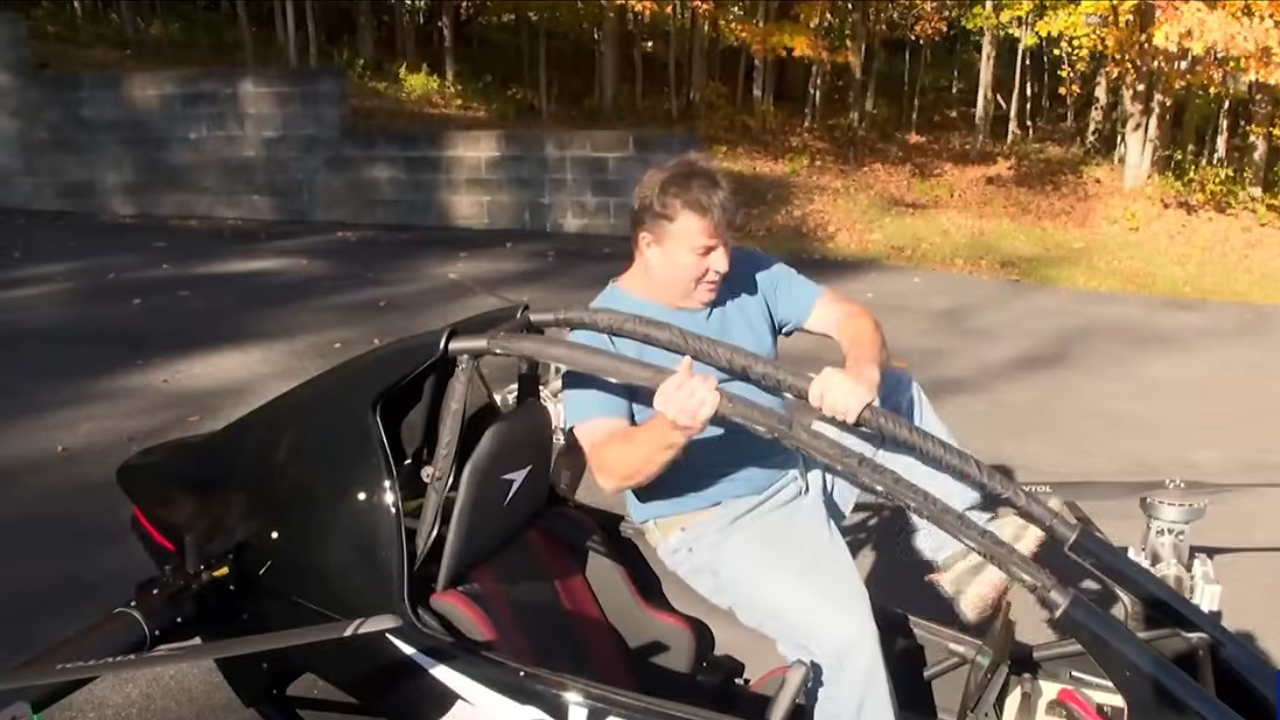
A New York couple spent $250,000 on a vehicle that doesn’t have wheels, doesn’t need a road, and can lift straight into the air. The strangest part? They don’t need a pilot’s license to fly it, as long as it qualifies under federal ultralight rules.
Chad Panipinto and his fiancée, Tanya Stefanella, are taking flight over their property in Livonia, New York, in an electric aircraft powered by eight propellers. It’s called the YIVTOL S-ZERO, and it looks more like an oversized drone than a traditional airplane.
The couple waited nearly a year to get their flying machine. Now, instead of driving somewhere to enjoy a ride, they can climb into the single-seat aircraft and take off from their own land.
For Panipinto and Stefanella, the purchase is about more than trying out new technology. It’s a chance to experience something that once seemed possible only in science fiction.
A $250,000 Flight
Embedded media follows; please allow a moment to load.
In an interview with WROC, the couple showed off the aircraft and explained what it’s like to operate their own flying machine.
Stefanella compared the experience to the futuristic world of The Jetsons, a cartoon that showed people traveling through the sky in personal aircraft.
Panipinto said he has flown in helicopters and jet airplanes, but the electric aircraft feels different because of how smoothly it moves through the air.
According to the couple, roughly 80% of the machine is made from carbon fiber, a lightweight material commonly used in high-performance vehicles and aircraft.
Operating the S-ZERO involves a simple control system. The pilot can start the propellers with a button and use a joystick to control movement.
The couple said they generally fly around their 70-acre property instead of taking the aircraft on long trips.
Built for Personal Flight
The machine comes from YIVTOL, a Chinese company developing electric vertical takeoff and landing aircraft, also known as eVTOLs.
Unlike a regular airplane, the S-ZERO doesn’t need a runway. Its electric motors turn multiple propellers to lift the aircraft straight off the ground. It can then move through the air and land vertically.
In a July 2026 announcement, YIVTOL confirmed that its first batch of S-ZERO aircraft had been delivered to customers in the United States. The company also said it had begun training customers to operate the machines.
The aircraft comes in different configurations, and flight time depends on which version a customer purchases.
The couple told WROC that their machine has up to 50 minutes of battery life and can reach an altitude of 1,500 feet. Those are reported capabilities rather than independently verified results from their flights.
YIVTOL’s original product information describes a range of models designed for recreational flight, with different battery capacities, payload limits, and equipment.
The couple’s $250,000 purchase price is also much higher than the advertised starting prices of some S-ZERO configurations. Their total reflects what they paid to obtain their particular aircraft, not necessarily what every buyer would spend.
No Pilot’s License?
Perhaps the most surprising part of the story is that operating a qualifying ultralight aircraft doesn’t require a pilot’s license.
Under Federal Aviation Administration Part 103, people can fly certain single-seat recreational aircraft without a pilot certificate or medical certificate.
However, the aircraft must meet specific requirements. A powered ultralight generally must weigh less than 254 pounds empty, subject to certain exclusions, and stay within federal speed and performance limits.
Qualifying Part 103 ultralights also don’t need FAA aircraft registration. That is different from the registration requirements for many conventional aircraft and recreational drones.
The rules do not mean someone can fly wherever they want.
Ultralight pilots cannot fly over congested areas or open-air gatherings of people. They must also follow restrictions involving controlled airspace, visibility, and other aircraft.
Because S-ZERO configurations can vary, whether a particular machine qualifies for Part 103 depends on its actual specifications.
Safety From Below
Stefanella doesn’t have to sit inside the aircraft to help Panipinto while he’s flying.
The couple demonstrated a ground controller that lets her monitor what he sees from the cockpit. They said the controller also gives her the ability to take over if something goes wrong during a flight.
That backup system could be useful if the pilot has trouble operating the aircraft.
The couple also emphasized that buyers should receive proper training before attempting to fly one.
Although federal rules don’t require a pilot’s license for qualifying ultralights, learning to operate a flying machine safely is still important.
YIVTOL has made training part of its American rollout. Its original delivery announcement said customer instruction was underway as the company introduced its aircraft to the U.S. market.
More Aircraft Coming
Panipinto and Stefanella aren’t the only Americans taking an interest in personal electric aircraft.
YIVTOL’s American expansion began earlier in 2026, bringing its single-seat flying machines to customers in several states.
The company also announced plans to participate in EAA AirVenture Oshkosh 2026, where visitors could see the S-ZERO on static display.
For now, Panipinto and Stefanella are enjoying their aircraft close to home. They hope future versions will offer longer flight times and allow them to travel farther.
Their current machine already gives them something few people have experienced: the ability to leave the ground from their own property without climbing into a conventional airplane.