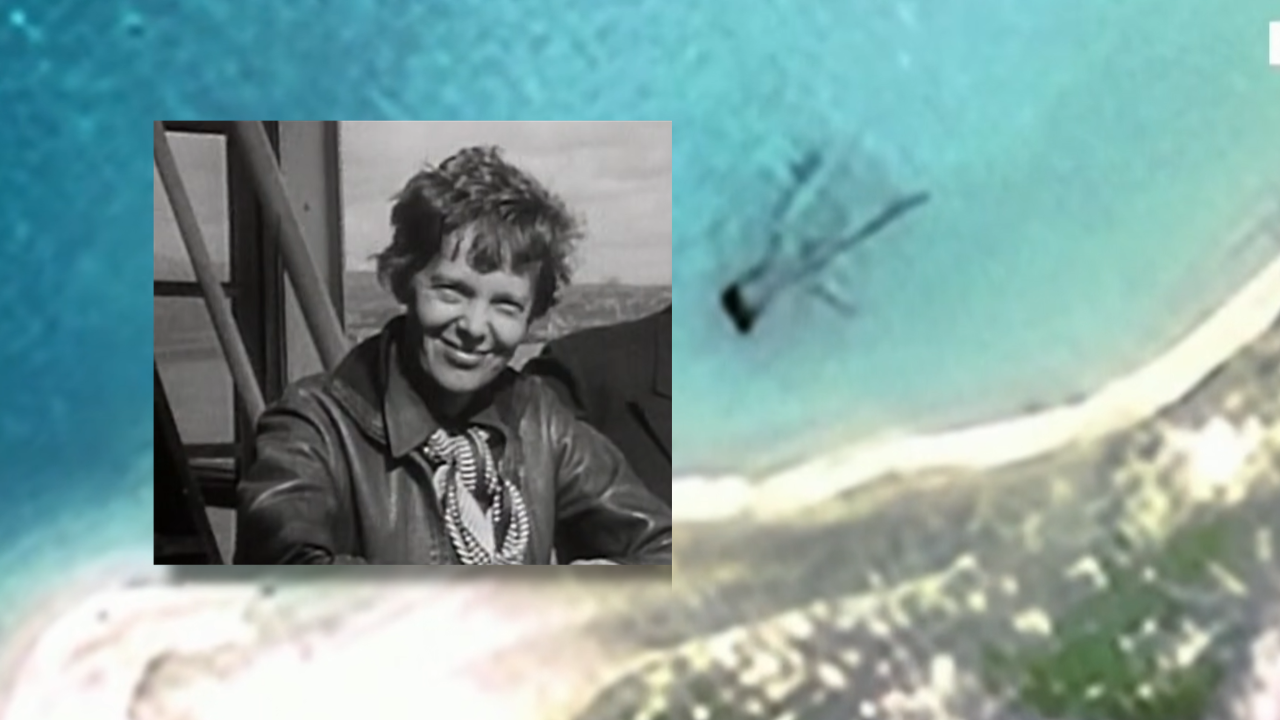
After five days crossing the South Pacific, a team searching for Amelia Earhart’s missing airplane has reached an uninhabited island in Kiribati. Getting there was only the first part: reaching the search site will require boats, equipment, and a trail cut through the jungle.
Purdue University announced that the 17-person Taraia Object expedition arrived at Nikumaroro on October 12 after an 830-nautical-mile voyage. A separate 17-person boat crew supports the mission aboard the Marin Mainiku, which reached the atoll around 8 p.m. local time.
Their target is an unidentified shape in satellite imagery that researchers hope could be part of Earhart’s Lockheed Electra 10-E. Estimates from aerial photographs place it about 10 feet from the lagoon’s shore, beneath as little as five feet of water depending on the tide, plus sediment of unknown depth.
Purdue’s connection to the aircraft began before Earhart’s final flight. The Purdue Research Foundation funded her “Flying Laboratory” through its Amelia Earhart Fund for Aeronautical Research. Rick Pettigrew, executive director of the Archaeological Legacy Institute, leads the current search.
The Last Stretch
Embedded media follows; please allow a moment to load.
Because the ship arrived after sunset, the team did not begin fieldwork immediately. Instead, the Marin Mainiku continued to the island’s eastern end for calmer overnight conditions while the expedition prepared to go ashore at daybreak.
The first day’s plan divided the work between two teams. One would take smaller boats through Tatiman Passage into the lagoon and place buoys to guide the return trip. The other would mark and cut a jungle trail connecting the beach landing site with a staging area on the lagoon’s south side.
Work was scheduled to shift to the Taraia Peninsula on October 14. Daily trips ashore will depend on tides and safe boating conditions, and everyone will sleep aboard the ship. Coconut crabs are one reason: their size and overnight activity make staying on the island impractical.
Under the Sand
At the peninsula, the team plans to survey a sand spit for surface artifacts before beginning the underwater work. Maritime specialists will lay out parallel search lines to create a grid for finding, measuring, and recording objects.
A magnetometer will search for iron-containing metals. Although the Electra was largely aluminum, steel cabling and other components could produce a reading. Sonar will help detect objects beneath the lagoon floor, and a hydroprobe will contact the target to establish its depth, orientation, and surface composition before a water induction dredge removes sediment for inspection.
The Archaeological Legacy Institute traces the lead to Michael Ashmore, who noticed the shape in an Apple Maps satellite image in 2020. Its proposed identification remains a hypothesis; the institute plans to examine the object’s material, shape, and rivet patterns for a match with the Electra.
The expedition has allowed five days for the field examination. If the object proves to be something else, the institute intends to document it. If it identifies Earhart’s aircraft, its next planned step is a full archaeological excavation in 2027.