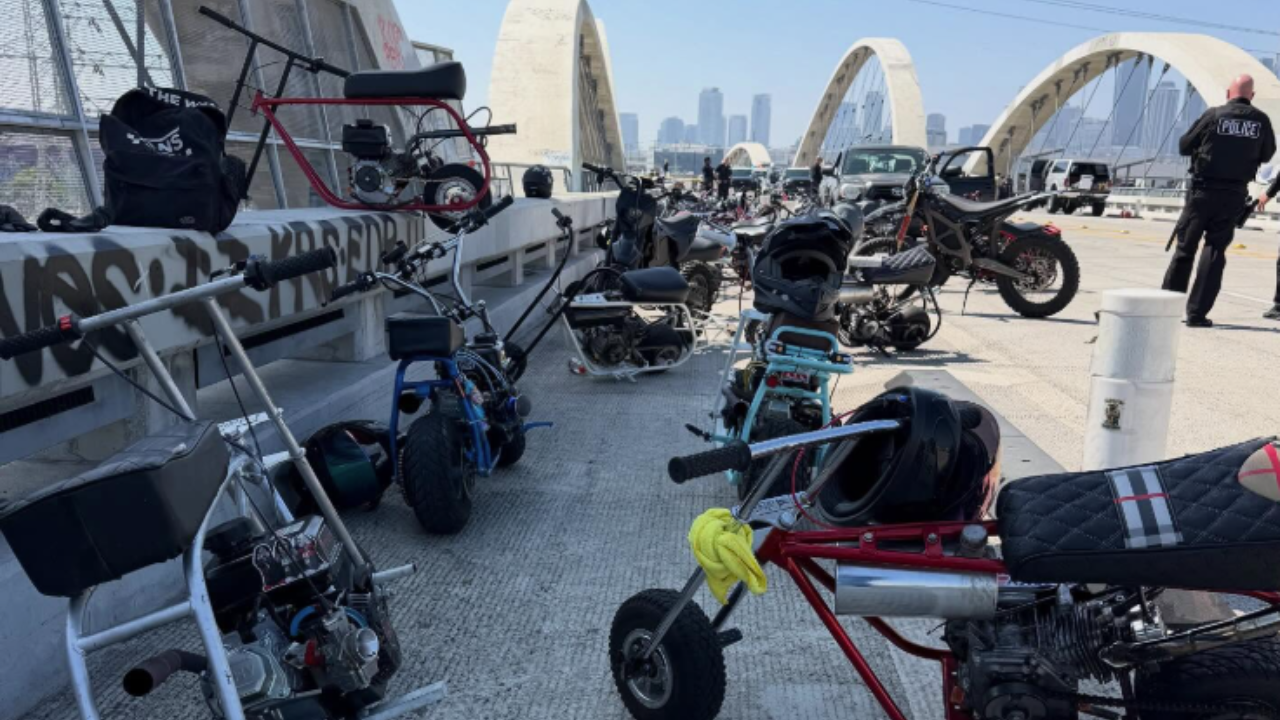
More than 70 people on motorized minibikes descended on Los Angeles’ Sixth Street Bridge on Sunday, doing wheelies and donuts, riding against traffic and weaving among vehicles while the group occupied the roadway.
Many of the riders were minors. But the Los Angeles Police Department said they did not arrive alone: adults drove lead and trail vehicles with the group, and some of those adults were identified as the children’s parents.
Officers from LAPD’s Operations Central Bureau and Street Racing Taskforce moved in on the riders. NewsChopper4 footage showed more than a dozen police vehicles surrounding the group while minibikes were loaded onto tow trucks, NBC Los Angeles reported.
The operation ended without anyone being injured. Riders received citations, minibikes were impounded and parents or guardians were contacted for the minors, but one family caught in the crackdown made clear that at least some of the adults had known exactly where their children were.
Along For The Ride
Embedded media follows; please allow a moment to load.
LAPD described the minibikes as particularly dangerous on an active roadway because of their low visibility, instability and lack of required safety equipment.
Police said the riders blocked the bridge while performing stunts, crossed onto the wrong side of the roadway and moved in and out of traffic. The department characterized its response as an effort to stop someone from being seriously hurt rather than an attempt to criminalize the young riders.
That distinction became less theoretical when ABC7 spoke with Marvin Deleon and his 13-year-old daughter, Leilani Deleon.
They told the station they had been taking part in a birthday rideout. Both father and daughter received citations, and both of their bikes were impounded.
Marvin Deleon defended allowing his daughter to participate, telling the station that he rode beside her. He also said police had stopped the riders previously and allowed them to continue as long as they wore helmets and did not block traffic or ride recklessly.
His daughter described being restrained with zip ties while officers held the group on the bridge.
The Fine Print
The citations point to a rule that is considerably less ambiguous about where these bikes can go.
California Vehicle Code Section 21720 says a pocket bike cannot be operated on a roadway, sidewalk or other part of a highway. The prohibition also covers bikeways, bicycle paths and trails, among other public areas.
That also answers a question raised repeatedly after LAPD posted photos from the operation: whether the impounded minibikes are simply gone for good.
They are not, at least not under the seizure provision LAPD cited.
Section 21721 allows a peace officer to seize a pocket bike after issuing a notice to appear for violating Section 21720. The law requires the bike to be held for a minimum of 48 hours.
After that period, the agency must release it to the owner, violator or an authorized agent if the request is made during normal business hours and the applicable removal, seizure and storage costs have been paid.
NBC Los Angeles reported that two accompanying vehicles were also impounded, although those face a much longer wait: 30 days.
A Familiar Stage
The choice of location brought its own baggage.
The Sixth Street Viaduct had been open for barely a week in July 2022 when drivers were already using it for burnouts and street takeovers. Police made dozens of citations and impounded vehicles during its opening weeks, while city crews installed speed bumps in an attempt to discourage the behavior.
Sunday’s group swapped cars for much smaller machines, but some of the behavior was familiar enough that LAPD’s Street Racing Taskforce was part of the response.
This time, the department emphasized what happened after the riders stopped. Officers contacted parents and guardians, discussed the risks with them and made sure the young riders got home without injury.
For the minibikes loaded onto tow trucks, California law puts the first possible trip home 48 hours later — after the associated removal, seizure and storage bills are paid.