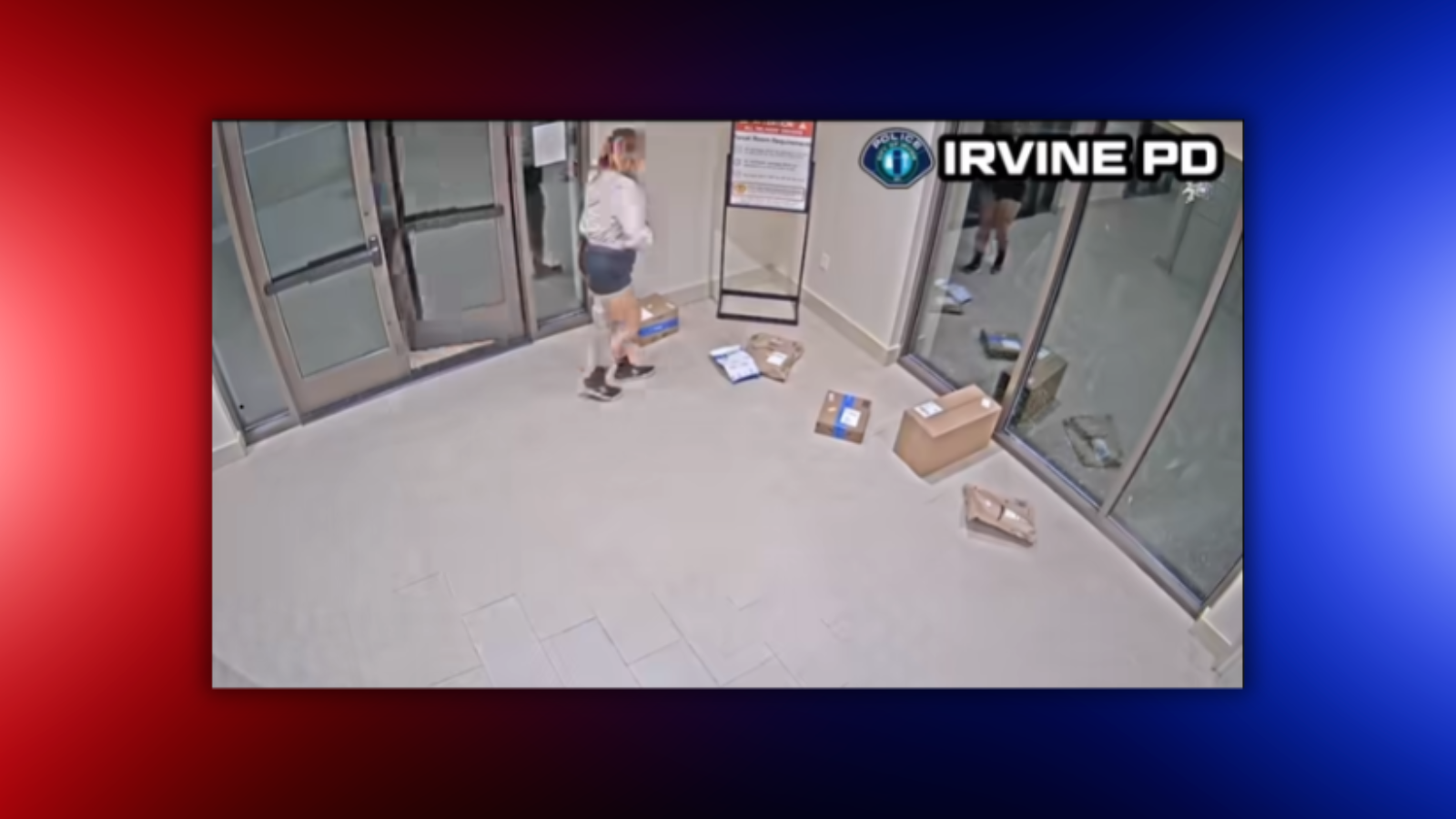
Schadenfreude, déjà vu, and a little delicious irony all meet in the parking lot of an Irvine apartment complex.
Early September 10, Irvine police officers recognized a vehicle leaving the Promenade Apartments as the suspect vehicle from a burglary there earlier in the month.
They stopped it after it exited the property and detained all three occupants. A search turned up multiple stolen packages belonging to Promenade residents and methamphetamine.
The Irvine Police Department said two occupants were arrested. The third person was released from detention.
A Familiar Address
Embedded media follows; please allow a moment for it to load.
View this post on Instagram
Demi Nicole Dugmore, 31, of Irvine, and Steven Michael Fernandez, 44, of Anaheim, were booked September 10 on allegations of burglary, possession of narcotics, and possession of burglary tools. Their bookings are listed in the Orange County Sheriff inmate system.
Irvine police set the reel to Anyma & Rebūke’s “Syren.” One commenter called the soundtrack “an absolute banger over this clip.” Another said the social media team “needs a raise,” drawing a three-dancing-emoji reply from the department.
One viewer said packages had repeatedly disappeared from their own apartment mail room. Another spotted dog treats among the property shown in the reel and joked about those being stolen too.
Close to Home
A successful burglary can leave an offender with useful knowledge for another attempt. They may know the layout, which doors or windows are vulnerable, when residents tend to be away, what valuables are likely to be inside, and what security they encountered.
Criminologists call that the “boost” explanation for repeat victimization.
Sometimes the address itself is the draw. Criminologists call that the “flag” explanation. Easy access, weak security, predictable periods of vacancy, valuable property, or other characteristics can attract different offenders independently.
A U.S. Department of Justice COPS Office guide cites a Tallahassee study in which 25% of repeat residential burglaries occurred within one week of the first offense. Within a month, the figure reached 51%.
Saskatoon produced an even steeper short-term risk. Another burglary within a month was more than 12 times as likely as expected, with half of those repeats occurring during the first seven days.
The effect can jump addresses. Researchers call another burglary close to the original target shortly afterward a “near repeat.” In an apartment complex, the next target may share the same floor plan, doors, windows, hallways, parking areas, or access points.
Multi-family housing can amplify the pattern. An Office of Justice Programs study covering Baltimore, Dallas, and San Diego found repeat risk for multi-family dwellings at roughly six times the expected rate in San Diego, 19 times in Baltimore, and 28 times in Dallas after an initial burglary.
A Curious Collection
A screwdriver or pair of pliers can spend years in a work truck without becoming contraband.
California Penal Code Section 466 nevertheless puts both on a list that also includes picklocks, crowbars, vise-grip pliers, water-pump pliers, slidehammers, slim jims, bump keys, floor-safe door pullers, and even pieces of ceramic or porcelain spark plugs.
The California Supreme Court confronted the difference in a case involving a teenager who entered a Sears store intending to steal jeans.
He had a pair of pliers and used them to remove an anti-theft tag. He then left without paying. A juvenile court sustained both the theft allegation and an allegation that he possessed burglary tools.
The burglary-tools finding did not survive.
In In re H.W., the California Supreme Court held that Section 466 requires intent to use the tool to break into or otherwise gain physical entry to a structure in order to commit theft or another felony inside.
The pliers helped carry out the theft, but they were used to remove the security tag after the teenager had already entered the store. That was not enough.
That is why the same screwdriver can be an ordinary work tool in one truck and evidence of a burglary-tools offense in another.
California expanded the statutory list on January 1, 2026, adding key-programming devices, key-duplicating devices, and signal extenders.
A signal extender can amplify a keyless-entry fob’s signal far enough to lock, unlock, access, or start a vehicle. The law also reaches devices capable of accessing a vehicle’s onboard computer to add or delete keys, remotely start the vehicle, or capture a key code or signal.
All parties are presumed innocent unless and until proven guilty in a court of law.