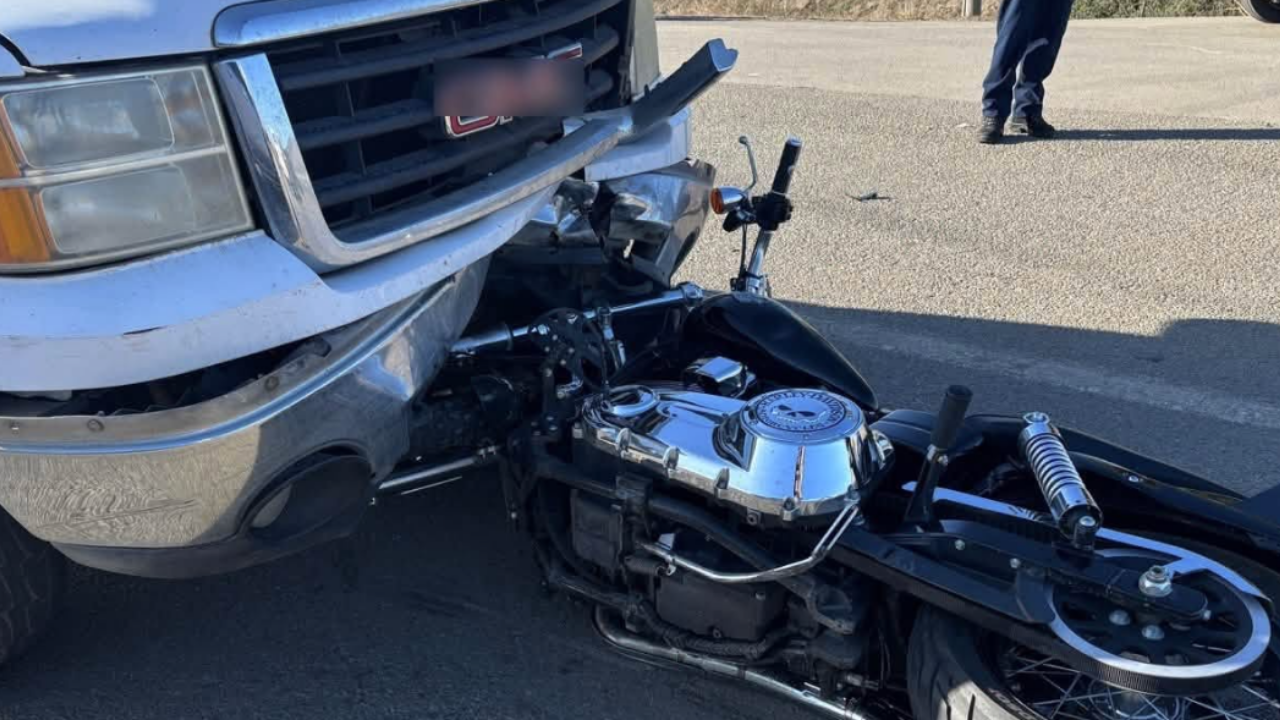
A white pickup sat angled across the center of State Route 129. A damaged motorcycle was down nearby. The double-yellow lines ran beneath the truck.
Facebook needed roughly one photograph and no measurements.
“White truck. Wrong lane. Double yellow,” one person wrote after CHP Santa Cruz posted images from the crash.
Several commenters concluded that the pickup had turned left into the motorcycle’s path. Another decided the motorcyclist had been passing on the wrong side. Someone else blamed lane splitting.
Those cannot all be the official finding, and none of them is.
CHP said the motorcycle and pickup collided Saturday afternoon, Aug. 29, for reasons that remained under investigation. The rider suffered major injuries and was taken to a local hospital.
The agency said the rider was wearing a DOT-approved helmet and credited it with playing a role in saving his life.
The post did not identify either person, describe their directions of travel, say that the pickup was turning or announce a citation. An archive of CHP incident data listed the call at State Route 129 and Carlton Road at 5:07 p.m.
What the Double Yellow Actually Means
The pickup’s position made the centerline the main exhibit in the Facebook prosecution.
California’s rules are not quite as simple as “crossed yellow, therefore guilty.”
California Vehicle Code section 21460 generally prohibits drivers from traveling to the left of double solid yellow lines. The same law allows a driver to cross those lines when turning left at an intersection or into or out of a driveway or private road.
That exception is relevant at this location. Caltrans describes the junction as a realigned intersection with a left-turn lane on Route 129.
A left turn there is an anticipated use of the road, not a maneuver categorically forbidden by the double yellow.
That does not establish that the pickup was turning, and it certainly does not clear its driver.
Under California’s left-turn rule, a driver intending to turn left must yield to approaching vehicles that are close enough to present a hazard. The driver must continue yielding until the turn can be completed with reasonable safety.
A pickup can therefore cross a double yellow legally while making a left turn and still violate the right-of-way rule by turning in front of approaching traffic.
The photograph does not establish whether that happened here.
One Photo, Two Opposite Stories
The photograph shows where the vehicles were when it was taken. It does not show where they were seconds before the collision.
It does not reveal the vehicles’ approach directions, their speeds, whether either driver signaled or braked, what each person could see or where the initial impact occurred.
The pickup’s resting position could be consistent with a left turn. It could also reflect movement produced by the collision or events after the initial contact. CHP has not publicly described the sequence.
That missing sequence did not stop another commenter from reaching the opposite verdict and claiming that the motorcyclist had tried to pass on the wrong side.
CHP’s post did not say the rider was passing. It did not accuse the pickup driver of failing to yield. It did not identify speed, distraction, impairment or any other contributing factor.
The same still image produced two conflicting crash reconstructions because the image does not contain enough information to support either one.
Lane Splitting Was Not in the Report
One commenter added lane splitting to the list of alleged causes, apparently as a general complaint about motorcyclists.
California law defines lane splitting as operating a two-wheeled motorcycle between rows of stopped or moving vehicles. It does not mean every instance of a motorcycle traveling near a centerline or overtaking another vehicle.
If the rider crossed into opposing traffic to pass, that would raise separate questions about passing and centerline rules. Nothing in CHP’s post says that occurred.
The released information also does not say the rider was weaving through traffic, traveling between rows of vehicles or otherwise lane splitting.
That theory came from the comments, not the investigation.
The Helmet Is the Part CHP Confirmed
While commenters were assigning fault, CHP made one direct statement about what influenced the outcome: The rider’s helmet helped save his life.
California requires motorcycle operators and passengers to wear properly fitted and fastened safety helmets that meet the applicable standards.
CHP used the familiar phrase “DOT-approved.” Federal regulators generally call the helmets DOT-compliant. NHTSA explains that manufacturers certify their helmets as meeting Federal Motor Vehicle Safety Standard No. 218 and place the DOT symbol on qualifying products; the agency does not preapprove individual helmets.
California is one of the states requiring helmets for every rider. As of August 2026, IIHS listed Illinois, Iowa and New Hampshire as the only states with no motorcycle helmet law. Most other states either cover all riders or apply requirements based on age and other conditions.
The national numbers help explain CHP’s emphasis. NHTSA reported that among 2023 fatalities with known helmet use, 51 percent of motorcyclists killed in states without universal helmet laws were not wearing helmets. The corresponding figure in states with universal laws was 10 percent.
The helmet did not prevent the rider from suffering major injuries. According to CHP, however, it may have prevented the crash from becoming fatal.
That is the conclusion supported by the agency’s post. The competing claims about an illegal turn, a bad pass and lane splitting remain speculation.
The double yellow is easy to see. Who had the right of way is still under investigation.