Pasco County was supposed to be getting different license plate readers. Instead, a large portion of the Sheriff’s Office-operated camera network is now scheduled to come down entirely.
Earlier this month, the Pasco County Sheriff’s Office confirmed that it was replacing approximately 60 Flock Safety automated license plate readers with equipment from Axon. Undersheriff Chase Daniels said the change would save about $50,000 while allowing the technology to integrate with systems the agency already uses.
That announcement made some of the reaction to the county’s latest news predictable. When Creative Loafing Tampa Bay reported that Sheriff Chris Nocco was terminating an agreement involving license plate readers, several readers concluded that Pasco was simply swapping Flock for Axon.
That was the plan. It is no longer the whole story.
Plans Changed
At an Aug. 11 Pasco County Commission meeting, Commission Chair Jack Mariano raised concerns about the license plate readers and the amount of information collected by the systems.
Mariano repeatedly distinguished those concerns from the way Pasco deputies had been using the technology. He said the Sheriff’s Office had handled the program responsibly, but questioned the larger implications of compiling vehicle-location information.
Daniels then gave commissioners a detailed presentation on Pasco’s program.
The Sheriff’s Office operated approximately 60 license plate readers at the time, Daniels said. Another roughly 110 cameras in Pasco County belonged to private entities such as businesses, homeowners associations, and community development districts.
Pasco’s cameras had been allowed in county-controlled public rights-of-way under an interlocal agreement unanimously approved by commissioners in December 2024.
Readers positioned along state roads operate under a different arrangement, with permits coming through the Florida Department of Transportation.
That distinction became important two weeks later.
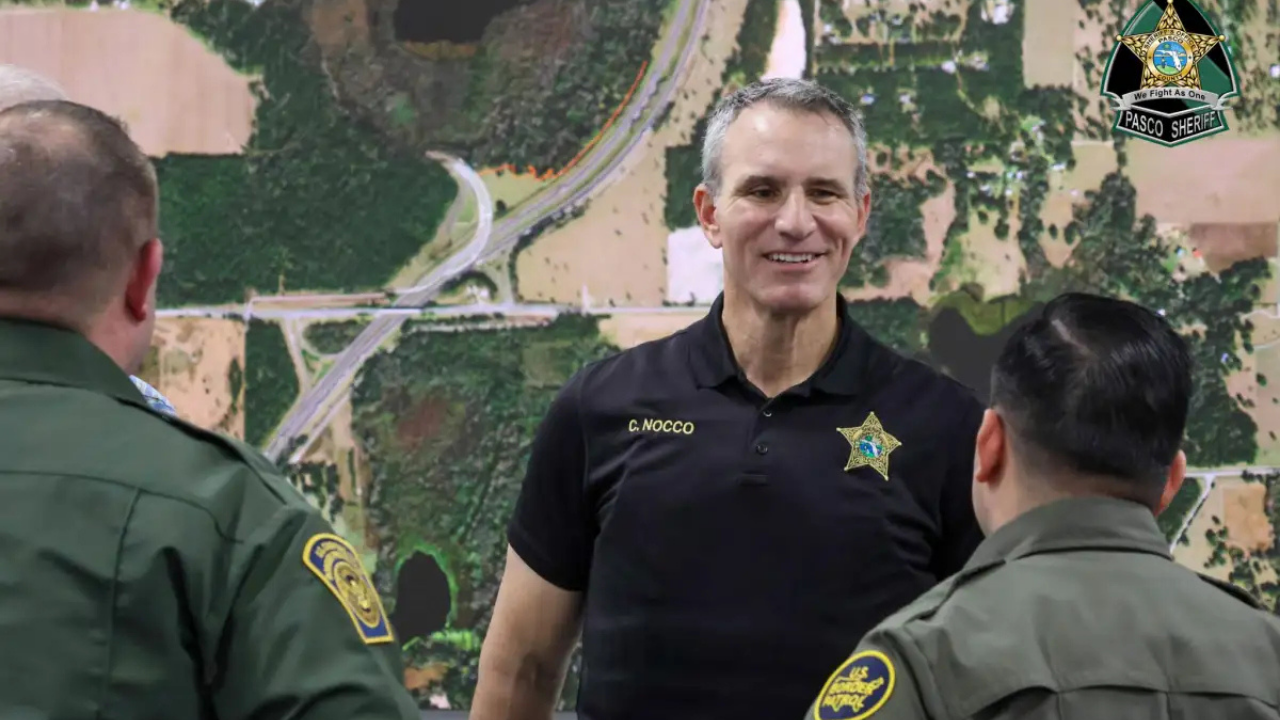
Following additional opposition at the Aug. 25 commission meeting, Nocco notified commissioners that he was terminating the interlocal agreement effective Sept. 30.
“It is disappointing that a majority of the Board of County Commissioners does not trust the Sheriff’s Office or our deputies,” Nocco wrote.
The decision means the Sheriff’s Office will no longer have the county agreement it needs to operate its license plate readers in county-controlled rights-of-way.
In other words, this went beyond canceling Flock.
The Sheriff’s Office had already been transitioning from Flock to Axon. Terminating the right-of-way agreement cuts off the underlying county authorization those replacement cameras would also require on county roads.
The Privacy Fight
The disagreement was not primarily about whether Pasco deputies had been caught abusing the system.
Daniels told commissioners that the Sheriff’s Office had found no violations of its license plate reader policies.
Pasco also imposed restrictions more stringent than those permitted by Florida law, according to the Sheriff’s Office.
Although state law allows information to be retained for up to 2 years, Pasco’s policy limited retention to 30 days. Searches were restricted to specified criminal investigations and public-safety purposes, and users had to associate a search with an active call or case and provide an explanation for why they were running it.
Approximately 400 of the Sheriff’s Office’s roughly 1,300 members had access after completing required training, Daniels told commissioners.
He also said searches were audited, including reviews of unusual activity such as an employee using the system outside that person’s normal working hours.
But Mariano’s concern went beyond Pasco’s internal controls.
“I don’t have any problem with the way you guys have actually done it,” Mariano later said about the Sheriff’s Office’s handling of the program. “The compilation of all the data is where the problem is.”
After Nocco announced the termination, Mariano welcomed it, describing the outcome as a response to residents concerned about Fourth Amendment protections and mass surveillance.
The disagreement reflects a much larger argument now unfolding around automated license plate readers.
Florida Gov. Ron DeSantis entered that debate this week, saying license plate reader deployment had gotten “out of control” and warning that he did not want Florida becoming a surveillance state.
DeSantis nevertheless said he wants police to retain useful investigative tools, putting him in much the same debate Pasco commissioners had been having locally: whether the benefits of quickly searching vehicle-location data outweigh the risks created by collecting it in the first place.
Not All Gone
Drivers should not interpret Pasco’s decision as the disappearance of license plate readers from the county.
The Sheriff’s Office itself stressed that point.
Private cameras owned by businesses, HOAs, CDDs, and other organizations are not covered by the terminated county agreement. Daniels told commissioners those privately operated systems already outnumbered the Sheriff’s Office’s approximately 60 cameras.
The Sheriff’s Office has also previously received license plate information voluntarily shared by private organizations.
Cameras placed within state-controlled rights-of-way present another distinction because those locations are permitted through FDOT rather than Pasco County.
Daniels also told commissioners that the Sheriff’s Office had agreements involving three license plate reader vendors: Flock Safety, Axon, and Motorola. He explained that different systems do not necessarily communicate with one another, making access to multiple systems useful when agencies or private organizations use different vendors.
So, the Sept. 30 termination is significant, but it does not erase the larger license plate reader network surrounding Pasco drivers.
Another Technology
The timing has also caused some residents to connect the camera fight with Pasco’s expanding use of drones.
There is a substantial drone project under consideration, but the two programs should not be treated as interchangeable.
An Aug. 25 county agenda included a Phase 1 recommendation involving $9 million in federal Community Development Block Grant Disaster Recovery funding for a Sheriff’s Office Drone as First Responder project.
The proposal calls for 21 weather-rated autonomous drone docks and 22 supplemental aircraft, with the Sheriff’s Office becoming the long-term owner and operator.
However, the $9 million figure is not yet equivalent to a completed drone purchase or final contract. County records describe it as a Phase 1 project recommendation, with funding still subject to eligibility review, environmental requirements, procurement, and execution of the necessary agreements.
Pasco’s existing drone program also predates the current license plate reader dispute. The Sheriff’s Office has been expanding its unmanned aircraft capabilities for years and has received federal approvals related to operating docked drones beyond the pilot’s immediate visual range.
Nothing in the county’s license plate reader decision establishes that those drones are replacing Flock or Axon cameras.
For the license plate readers, the immediate consequence is much simpler: a program that was headed for a vendor change at the beginning of August is now headed toward removal from Pasco County-controlled roads by the end of September.