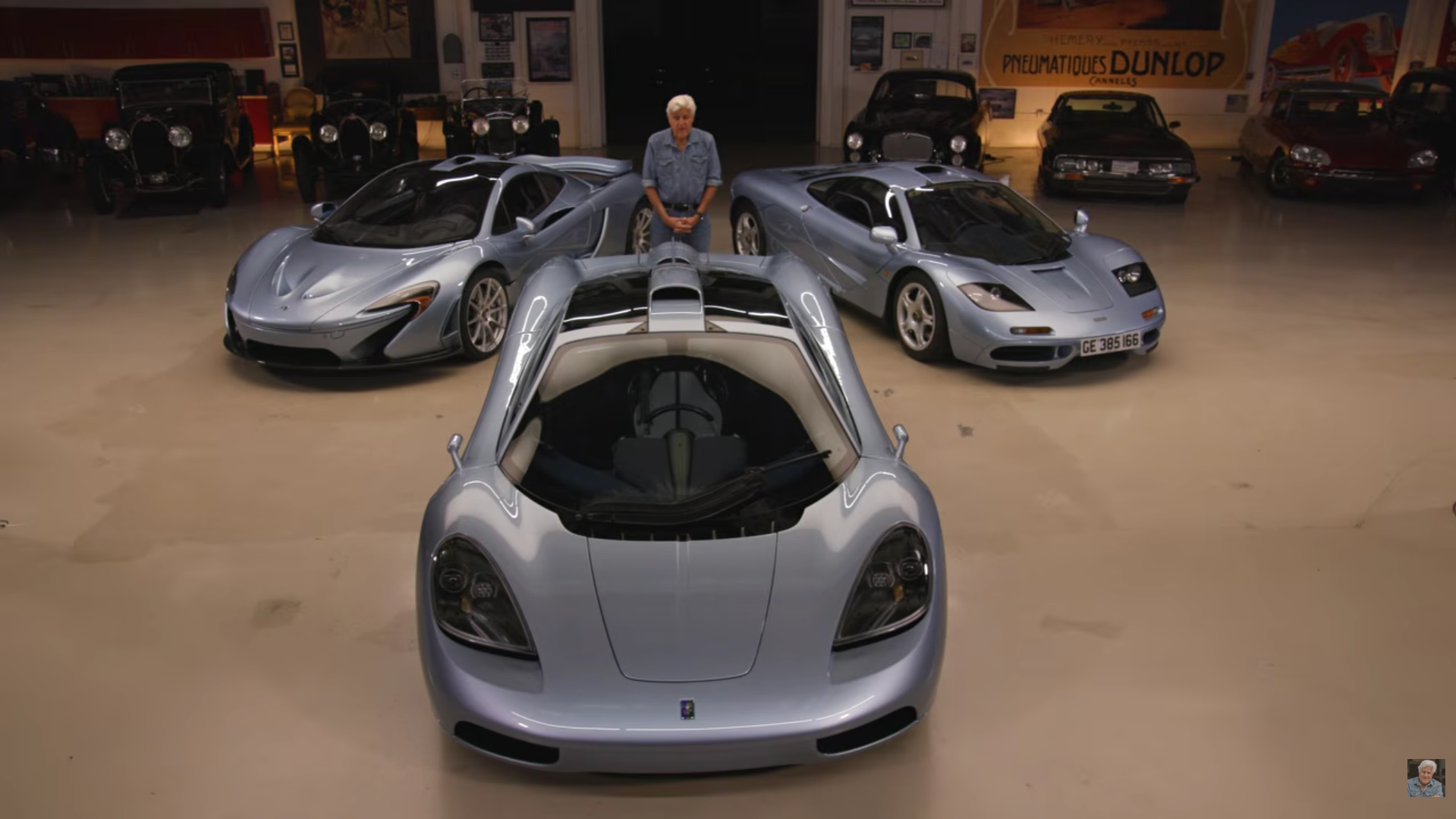
Jay Leno has driven enough rare machinery to make most collectors jealous, yet even he does not often get handed the keys to something that feels like a genuine successor to the McLaren F1. The Gordon Murray Automotive T.50 managed to get exactly that reaction.
The car arrived at Jay Leno’s Garage courtesy of fellow collector Dan Heard, who brought along an extraordinary three-car lineup. Sitting together were a 1995 McLaren F1, a McLaren P1, and the new GMA T.50, three machines connected in different ways by Gordon Murray’s philosophy.
Leno already owns an F1 and a P1, giving him an unusually useful reference point for evaluating the T.50. Once he finally got behind the center-mounted steering wheel, the comparison quickly became less academic.
What impressed him most was not some outrageous top-speed figure or enormous horsepower number. Instead, it was how much excitement the T.50 delivered without needing to travel at absurd speeds.
The McLaren F1 Still Sets The Standard
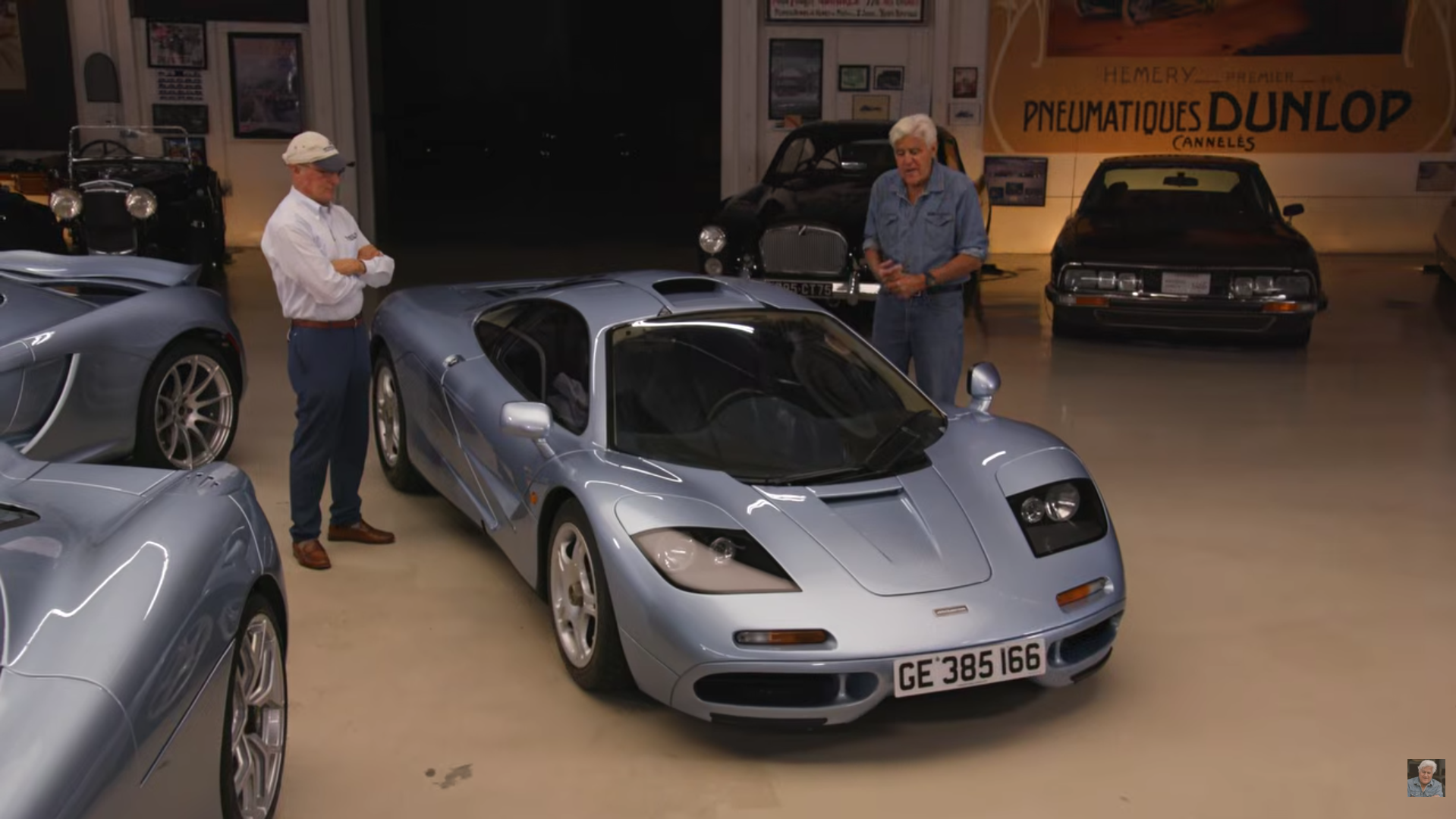
Before driving the T.50, Leno and Heard spent considerable time discussing the McLaren F1, the car that established Murray’s reputation for obsessive lightweight engineering. Leno described it as revolutionary rather than evolutionary, pointing out that even decades later its proportions and design still look remarkably contemporary.
The F1 combines a naturally aspirated 6.1-liter BMW V12 with a six-speed manual transmission and weighs roughly 2,500 pounds. Leno also highlighted Murray’s famous obsession with reducing mass, including tiny engineering decisions that saved only ounces at a time.
That purity came with very little electronic assistance. Leno recalled once getting wheelspin at highway speeds after downshifting and accelerating hard, a sharp reminder that the F1 lacks the safety nets found in modern hypercars.
The T.50 Takes The Same Idea Further
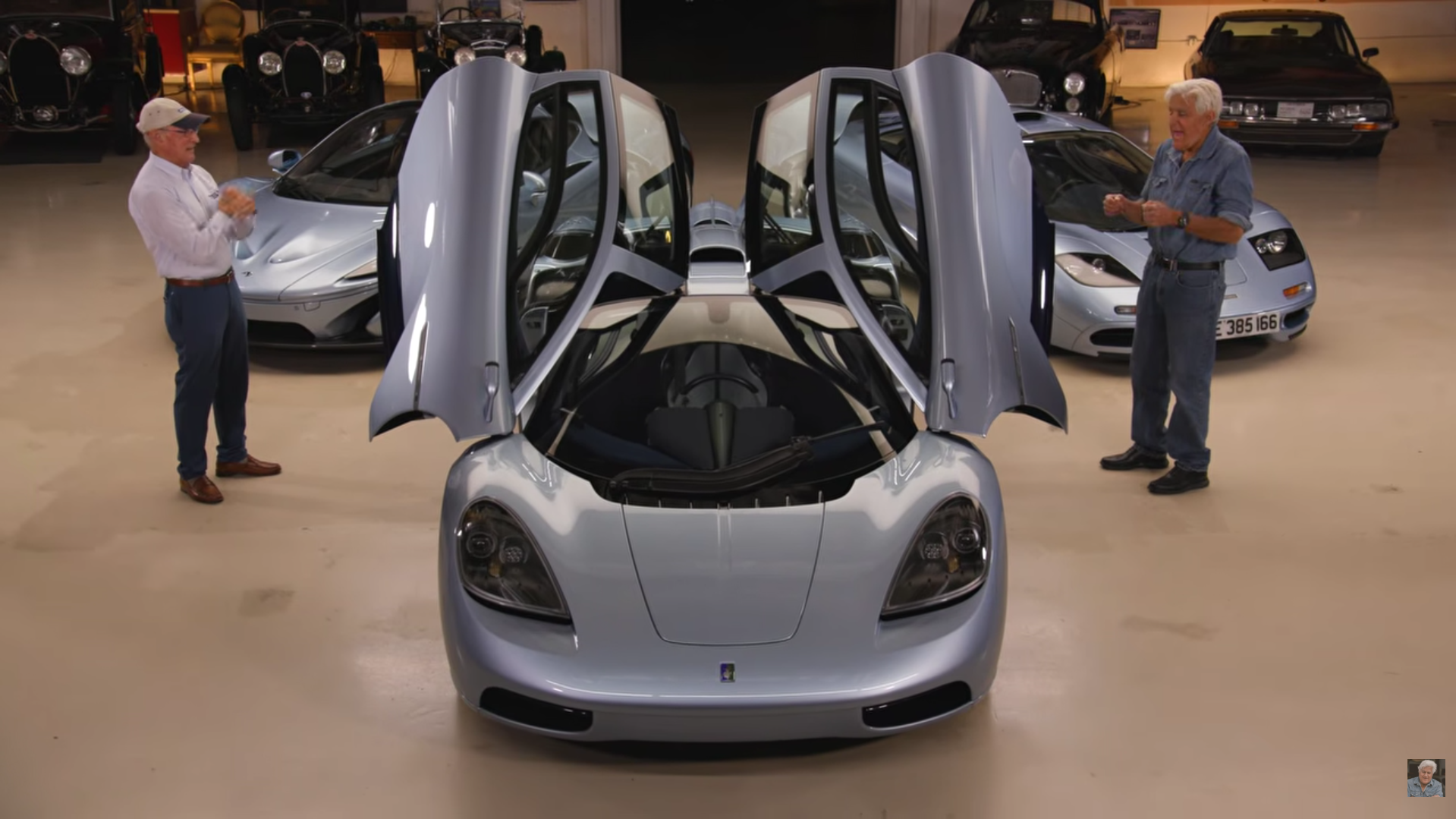
The T.50 follows the same basic recipe but applies three decades of additional engineering knowledge. Its 3.9-liter Cosworth V12 produces 654 horsepower in normal operation, rising to around 690 horsepower with V-Max Boost, and screams all the way to a 12,100-rpm redline.
Just as important is the car’s weight. At roughly 2,174 pounds, the T.50 is lighter than the McLaren F1 despite modern crash regulations and safety requirements that did not burden the original car to the same extent.
A six-speed manual transmission keeps the experience deliberately old-school, while the three-seat layout once again places the driver in the center. Heard’s car also retains the central philosophy of keeping electronics and complexity from overwhelming the actual driving experience.
That Giant Rear Fan Is Not For Show
One of the T.50’s defining features is the large fan at the rear, an idea with direct roots in Gordon Murray’s earlier race-car engineering. Rather than relying on a huge fixed rear wing, the system manipulates airflow beneath and around the car to improve aerodynamic performance.
Different modes alter how the fan behaves depending on what the driver wants. High-downforce settings help when grip matters, while streamline and V-Max modes prioritize reduced drag and higher-speed performance.
Leno openly admitted that he had grown to love the fan after initially being unsure about its appearance. Its appeal, in his view, comes largely from the fact that it exists for a genuine engineering reason rather than decoration.
Jay Leno Finally Gets Behind The Wheel
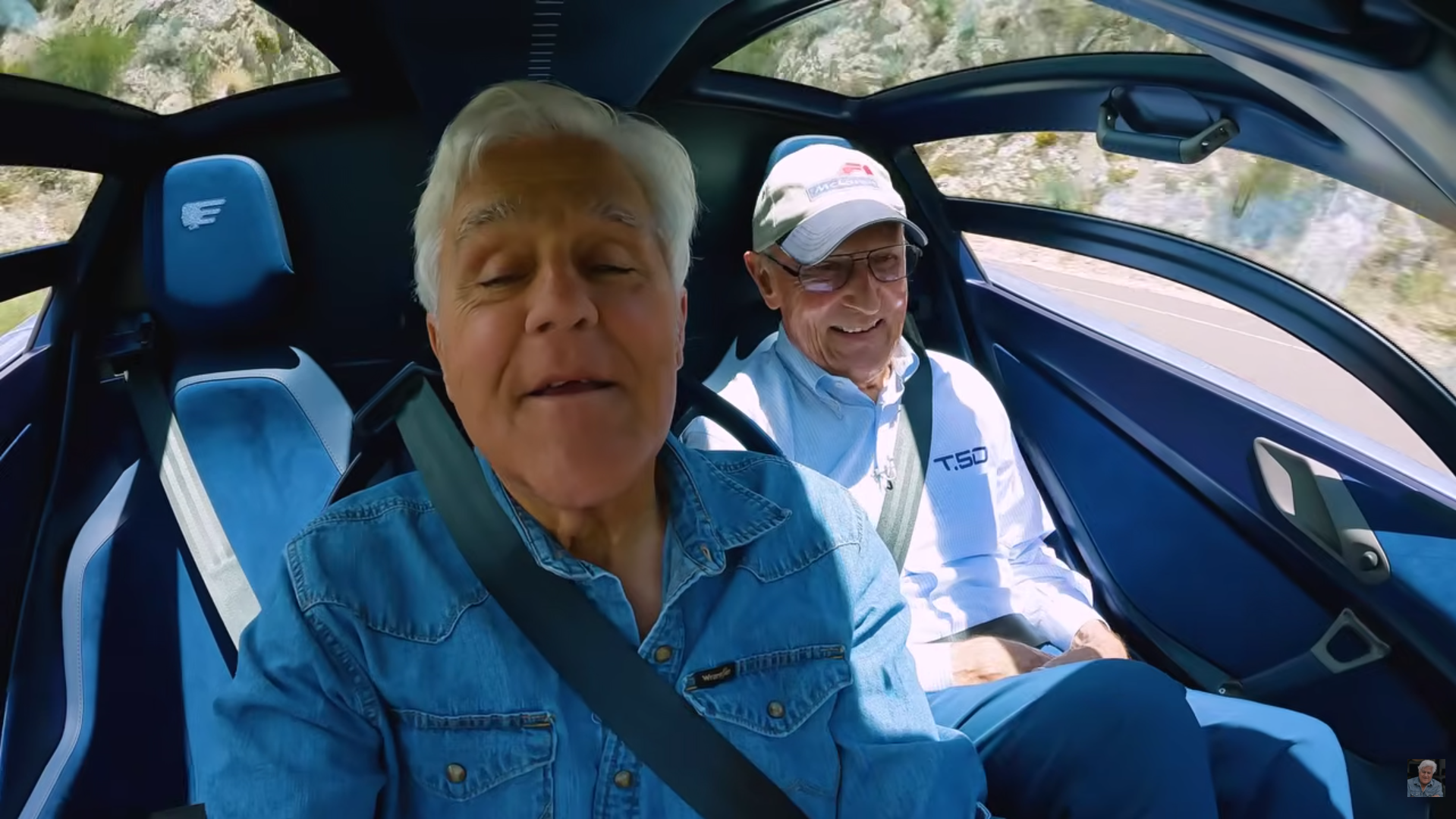
Once on the road, the centerpiece of the T.50 experience immediately became obvious: that V12. Heard explained that the engine feels comfortable between roughly 5,000 and 7,000 rpm, while peak torque arrives much higher than drivers accustomed to conventional engines might expect.
Leno repeatedly had to remind himself that the engine was nowhere near its limit. At one point, he noted that he was only around 9,000 rpm and was already smiling at just how outrageous the engine sounded.
The high-revving character also changes the sensation of speed. Leno remarked that he could be enjoying the car immensely at relatively ordinary road speeds, something he finds increasingly rare among modern performance cars designed to feel effortless even well into triple digits.
An F1 Successor Only Gordon Murray Could Build
Leno’s strongest takeaway was that the T.50 feels like an improved version of the McLaren F1 rather than something attempting to replace its philosophy. The steering is better, the brakes are better, the front end feels more secure at speed, and the entire car feels even more agile.
Heard described it similarly, saying the T.50 fundamentally drives like the F1 while doing almost everything better. Leno eventually summed it up with perhaps the most flattering comparison possible, calling it “the world’s greatest Miata.”
That description captures the appeal surprisingly well. The T.50 is staggeringly exotic and enormously expensive, yet the central idea is based around low weight, a manual gearbox, hydraulic steering, a screaming naturally aspirated engine, and enough feedback to make normal speeds entertaining.
Leno ultimately declared that “only Gordon could build the successor to the F1,” comparing Murray revisiting his greatest creation to Francis Ford Coppola returning for The Godfather Part II. After hearing the T.50’s V12 climb toward five figures on the tachometer, it is difficult to argue with him.
Would you rather have the original McLaren F1 or Gordon Murray’s modern T.50? Let us know in the comments.