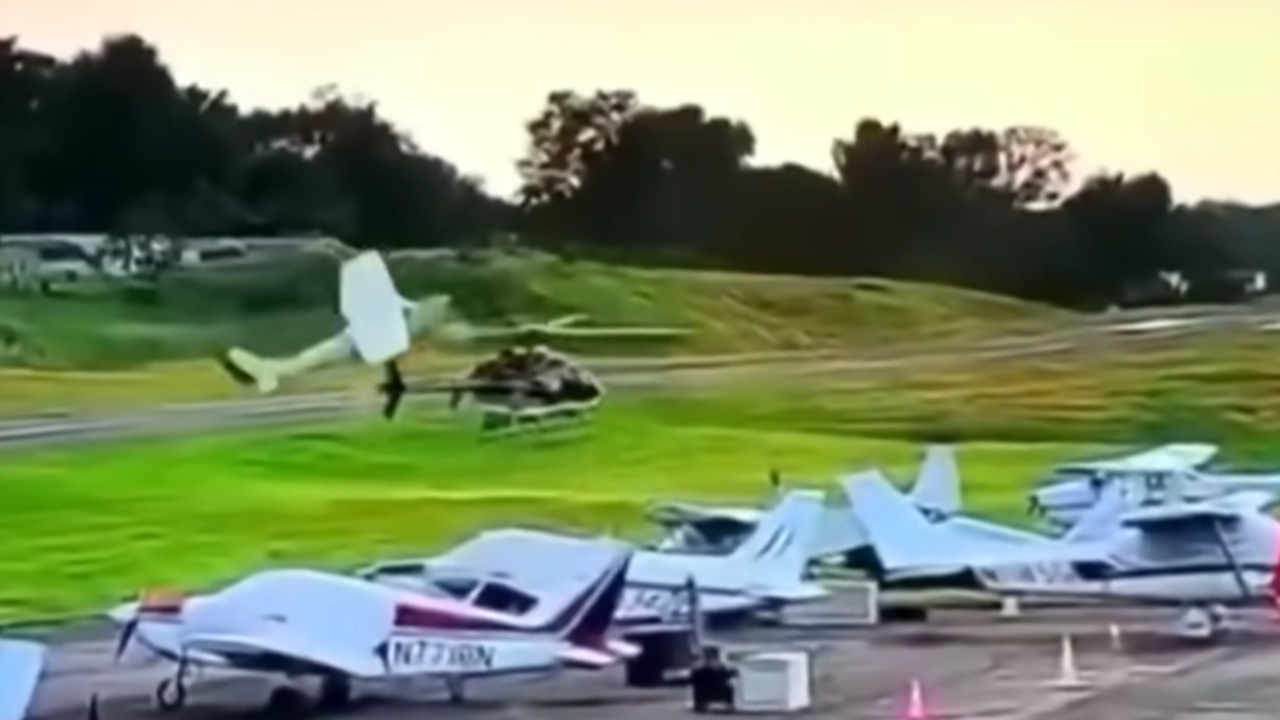
A small plane suddenly pitches upward, banks left, and then flies directly into the back of a Pennsylvania State Police helicopter hovering just feet above the ground. Newly released surveillance video captured the violent collision from beginning to end.
The crash happened Wednesday evening at Carlisle Regional Airport in Cumberland County, Pennsylvania. The Cessna 150 broke apart after striking the helicopter, killing its lone pilot, while the helicopter crashed onto the grass with two state troopers trapped inside.
Now investigators have a much stranger question to answer than the video alone can resolve. According to the National Transportation Safety Board, the Cessna and helicopter crews had communicated before the crash and were aware of each other.
The NTSB is focusing on what investigator-in-charge Aaron McCarter described as an “unusual” flight path immediately before impact. Investigators still don’t know why the Cessna made those maneuvers, and McCarter cautioned against trying to fill in that blank before the evidence does.
The Video Shows The Collision
Embedded media follows, please allow a moment for it to load.
NBC News obtained surveillance video showing the final seconds before the collision.
The Pennsylvania State Police helicopter can be seen hovering low over the airport grounds as the Cessna approaches. The small plane’s nose rises sharply, the aircraft turns, and moments later it strikes the rear of the helicopter.
The impact sends pieces of the Cessna flying as the plane tumbles across the grass. The helicopter also goes down, eventually coming to rest on its side.
The video establishes what happened in those final seconds. Why the Cessna ended up on that flight path is another matter entirely.
Investigators Reconstruct The Final Moments
The helicopter crew was conducting a training flight at the airport when the collision occurred. According to the Pennsylvania State Police, the aircraft involved were a Cessna 150 and a Pennsylvania State Police helicopter.
McCarter said the helicopter was performing a maneuver known as a “hover taxi.” Rather than landing and rolling along the ground like an airplane, a helicopter remains a few feet in the air while moving slowly forward.
The helicopter had approached normally and was hovering roughly three to 10 feet above the ground as it moved away from the runway.
Then came the Cessna.
“The Cessna came in, straight and level, suddenly increased its pitch, severe nose up, did a left turn, leveled off again, and then flew into the back of the helicopter,” McCarter said during Thursday’s NTSB briefing.
He called the Cessna’s flight path “unusual.”
“Right now we don’t know the details of why the pilot was flying in that manner,” McCarter said, “but we are going to find out.”
Both Crews Had Been Communicating
Carlisle Regional Airport does not have an air traffic control tower. That isn’t unusual for smaller airports, and it doesn’t mean pilots simply fly around without communicating with each other.
Pilots at airports like Carlisle use a common radio frequency to announce their positions and intentions to other aircraft operating nearby.
In this case, investigators say communication took place.
“Communication was established between the flight crews,” McCarter said.
That gives investigators another potentially valuable piece of evidence. The NTSB will examine the communications as it works to determine what each pilot knew, what was said, and how the two aircraft still ended up occupying the same space.
The fact that Carlisle is a non-towered airport has not been identified as a cause of the collision.
The Cessna Had Been Worked On Earlier That Day
Investigators are also looking into what happened before the Cessna’s final flight.
According to McCarter, a witness reported seeing the pilot working on the airplane earlier Wednesday. He subsequently flew out of Carlisle for what investigators understand was some type of training before returning to the airport.
There is no evidence at this point that the earlier work on the airplane contributed to the crash.
McCarter said investigators had not found anything obvious in the wreckage that immediately explained what happened and urged people not to speculate while the investigation is still in its early stages.
The wreckage from both aircraft is expected to be moved to a specialized facility in Delaware, where investigators can examine it away from the active airport environment.
The NTSB plans to examine the aircraft, pilots, operating environment, communications, and other evidence before determining a probable cause. A final determination in an aviation investigation can take a year or longer.
An Experienced Pilot Was Killed
The Cumberland County Coroner identified the Cessna pilot as 57-year-old Paul William Sokoloski of Hershey, Pennsylvania.
Sokoloski was not a novice pilot. FAA records cited by CNN show he held qualifications to fly single-engine, multiengine, and commercial aircraft.
He was also an emergency medicine physician with Penn State Health.
“The Penn State Health community is deeply saddened by the loss of Dr. Paul Sokoloski, a valued member of our emergency medicine team,” the health system said in a statement reported by NBC Philadelphia.
The Cessna was registered to Sokoloski’s home address, according to FAA records cited by CNN.
The Troopers Managed To Escape
Pennsylvania Gov. Josh Shapiro identified the helicopter pilots as State Police Corporal Pilot Bryce Corman and Trooper Pilot Jason Mills.
Both men survived an impact that Pennsylvania State Police Acting Commissioner Lt. Col. George Bivens described as “very violent.”
They were initially trapped inside the wrecked helicopter. Bivens said Corman was able to push out a window and then help Mills, who appeared to have more serious injuries, get out of the aircraft before emergency crews reached them.
Both troopers were airlifted to Penn State Health Milton S. Hershey Medical Center.
Corman has since been released from the hospital, according to Pennsylvania State Police. Mills remained hospitalized in stable condition as of Thursday.
“Tonight could have been much worse,” Shapiro said after visiting with the troopers and their families. “Tonight could have been much more tragic for our state police family.”
For investigators, the surveillance footage provides an unusually clear look at the collision itself. The harder part is figuring out what happened in the seconds and minutes before the camera captured it, and why an experienced pilot flying an aircraft whose crew had communicated with the helicopter suddenly ended up on a collision course with it.