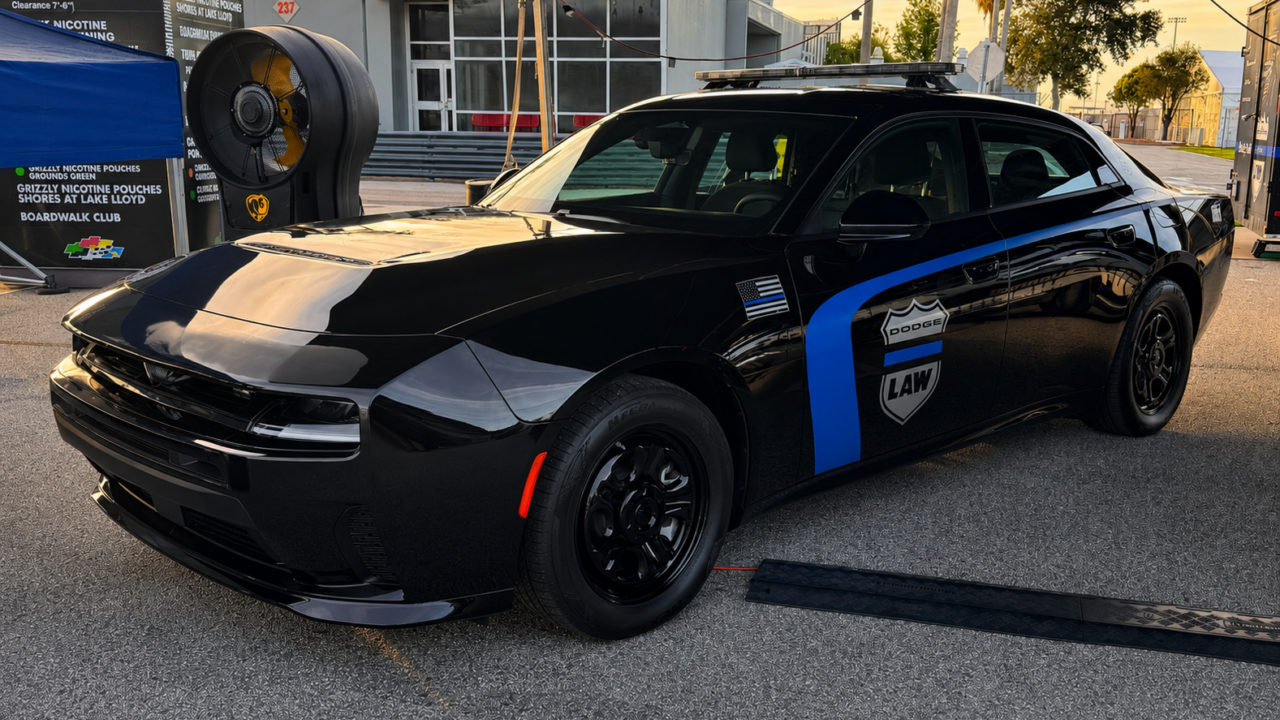
The Dodge Charger is getting ready to return to police duty. After the previous-generation sedan disappeared from production, Dodge is developing a new police-spec version of its latest Charger that could begin joining law enforcement fleets in 2027.
Dodge Law recently showed a prototype Charger Police Pursuit Vehicle to law enforcement fleet professionals in Daytona. While plenty of details remain under wraps, the company has confirmed two important ingredients: a turbocharged Hurricane inline-six and standard all-wheel drive.
That combination makes the new Charger considerably different from the V8-powered police cars many departments previously used. It also arrives in a market where traditional police sedans have almost completely disappeared in favor of SUVs and crossovers.
The Charger could consequently find itself occupying a very lonely corner of the fleet market. If the production model follows through on Dodge’s plans, it will offer police departments something that’s becoming increasingly difficult to find: a purpose-prepared pursuit car with the low center of gravity and road manners of a passenger car.
The Charger Is Going Back On Patrol
View this post on Instagram
Dodge hasn’t released complete specifications for the Police Pursuit Vehicle, including exactly how much power its 3.0-liter Hurricane engine will produce. The civilian Charger Sixpack is offered with different versions of the twin-turbo six-cylinder, but there’s no guarantee police departments will receive the most powerful configuration.
Fleet requirements are considerably different from those of enthusiasts. Reliability, operating costs, fuel requirements, cooling performance, and ease of maintenance can matter far more than winning a horsepower argument.
Standard all-wheel drive should nevertheless give the Charger a useful advantage for departments operating in rain, snow, and other difficult conditions. It also gives officers plenty of traction when the car is asked to accelerate quickly during pursuit duty.
The absence of a V8 might disappoint anyone nostalgic for the previous Charger Pursuit, but the Hurricane six should provide considerably more performance than the average patrol vehicle needs.
Police Sedans Have Nearly Vanished
View this post on Instagram
For years, American police fleets were filled with sedans including the Ford Crown Victoria, Chevrolet Caprice, Ford Taurus-based Police Interceptor, and Dodge Charger. One by one, those models disappeared as manufacturers and consumers moved toward SUVs.
The Ford Police Interceptor Utility, based on the Explorer, has become an especially familiar sight. Its popularity makes practical sense because police vehicles carry substantial amounts of equipment, including communications hardware, medical supplies, computers, weapons storage, and other gear.
Dodge’s latest Charger does have one trick that could help it compete. Despite its sedan-like profile, the car uses a liftback design with a large rear hatch, providing substantially better cargo access than a conventional trunk.
That could make it easier to accommodate police equipment without completely sacrificing the dynamic advantages of a lower passenger car.
There’s More To A Cop Car Than Lights And A Siren
Turning a civilian Charger into a proper police vehicle requires far more work than installing a lightbar and painting “POLICE” across the doors. Pursuit vehicles must withstand extended idling, repeated hard acceleration and braking, harsh road conditions, and long shifts with substantial electrical loads.
The cabin also needs to accommodate radios, computers, partitions, and officers wearing bulky duty belts. Even seemingly minor details such as seat bolstering can require changes because heavily sculpted sports seats aren’t particularly useful when an officer has equipment hanging from their waist.
Dodge hasn’t revealed the Charger PPV’s complete equipment package, performance figures, pricing, or which agencies might receive the first production vehicles.
Its biggest challenge may simply be convincing fleet managers that they still need a car at all. Police SUVs dominate the market for practical reasons, yet for departments that still want something lower, quicker, and designed with pursuit duty in mind, the Charger could soon be back in a familiar role: appearing in the rearview mirror and prompting an immediate glance at the speedometer.