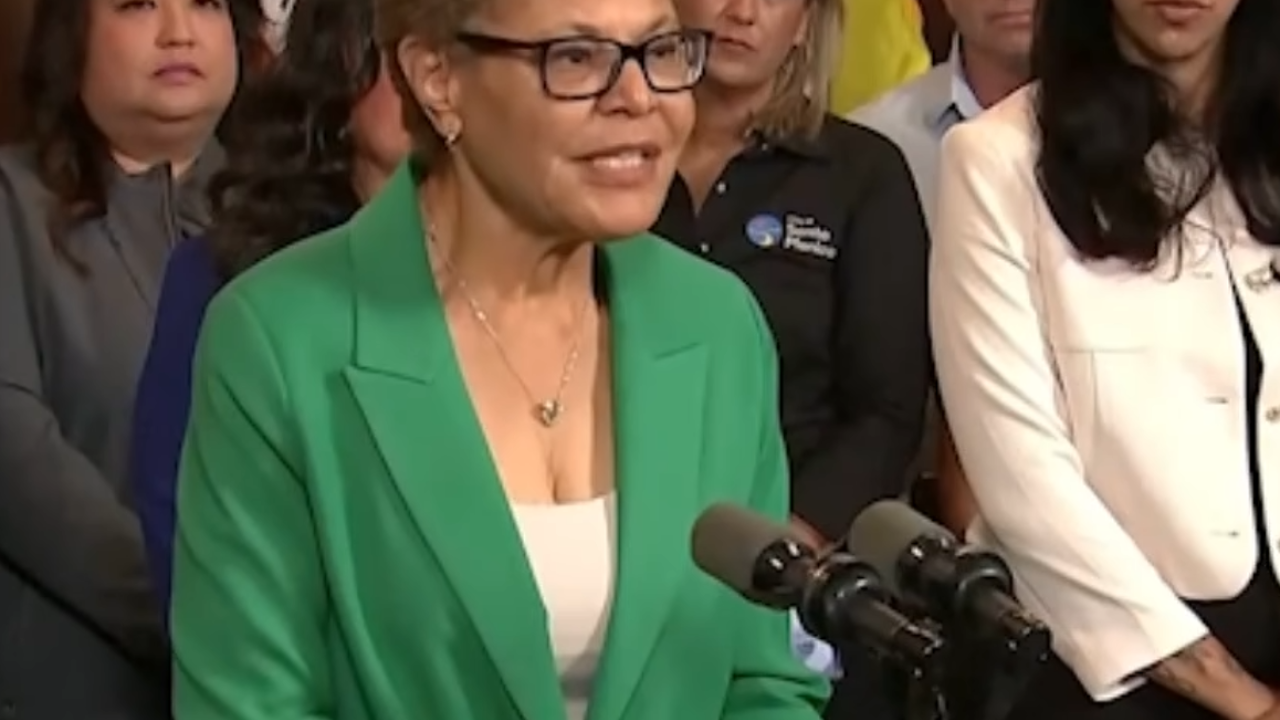
A self-described polling company managed to get a fabricated Los Angeles mayoral poll into the news, onto social media, and even into the incumbent mayor’s campaign messaging before admitting there was never a real poll at all.
Median Strategies claimed Los Angeles Mayor Karen Bass held a nearly 12-point lead over City Councilmember Nithya Raman ahead of the Nov. 3 runoff. The survey came with the trappings readers expect from legitimate polling: 560 Los Angeles voters, survey dates of July 30 through Aug. 5, and a stated margin of error of 4.1%.
There was just one substantial problem. According to the Los Angeles Times, Median Strategies acknowledged Monday that the survey was bogus.
The company said Median Strategies had been created as a short-term “social experiment” to see how purported polling information could enter the political information ecosystem and spread without independent verification.
A Fake Poll Found Real Readers
Embedded media follows; please allow a moment for it to load.
The fabricated numbers were unusually specific.
Median claimed that 16% of its respondents had voted for reality television personality Spencer Pratt in the mayoral primary. Of those supposed Pratt voters, about 85% planned to support Bass in November, while roughly 7% backed Raman.
That gave the poll a ready-made political storyline: voters who had supported Pratt were supposedly breaking overwhelmingly toward Bass.
The California Post picked up that angle in coverage of the poll, reporting that Pratt voters could become a deciding factor in the runoff.
Bass’s campaign also shared the favorable numbers.
“Doing the work, showing up, and gaining momentum. Let’s do this, LA!” Bass wrote in a since-deleted X post citing Median Strategies.
After the poll was exposed, Bass campaign spokesman Alex Stack told the Associated Press that the poll “was reported on by multiple news outlets.”
“Any bad faith attempts to influence elections should be investigated and prosecuted to the fullest extent of the law,” Stack said.
Then There Was Median Strategies
Median did not have much of a track record to examine.
The organization had only begun posting on social media earlier in August, and AP reported that its website had been created little more than a week before the company shut it down.
Its first social media post presented Median as a solution to problems within the polling industry.
“Polling has a credibility problem. Ours is the fix: no partisan clients, no campaign or party money, numbers that go wherever the data takes them even when it’s inconvenient. Trustworthy polling, rebuilt,” the company wrote.
Median went on to publish fake polling in three states, covering the Democratic primary for governor in Wisconsin, the Nevada governor’s race, and the Los Angeles mayoral election.
The New York Times, RealClearPolitics, and polling aggregator FiftyPlusOne did not include Median’s numbers in their databases, according to AP.
Will Davis, director of Election Data Analytics at The New York Times, said Median’s release lacked basic information about how its poll had supposedly been conducted and who was behind the company. The Times asked Median for more information and received no response.
FiftyPlusOne Head of Research Mary Radcliffe found additional holes in the Wisconsin poll’s methodology statement, including missing information about the voter file Median claimed to have used and the vendor that supposedly fielded part of its sample. Median did not answer her questions either.
Who Was Behind Median Strategies?
Median declined to identify the people involved when questioned by the Los Angeles Times, and AP reported that nobody responded to questions sent to the email address listed on its website.
Before the website disappeared, Median replaced its polling releases with a notice saying the project had ended and that all of its previous polling should be withdrawn and not treated as genuine data.
The company also published a financial disclosure denying outside funding or direction, as well as any financial benefit for those involved.
Median claimed that no individual involved received compensation or financial benefit from the project and that it was not funded, commissioned, or directed by a candidate, campaign, political party, PAC, media organization, or other outside entity.
It also addressed election prediction markets directly, claiming that nobody involved with Median held or traded a position tied to any of the races it covered and that the project was not undertaken for financial gain or to influence the value of a prediction-market position.
Those are Median’s claims. Because the people behind the operation remain anonymous, outsiders have no way to independently scrutinize who “the individuals involved” were.
The LA Poll Had Another Audience
AP also examined activity on election prediction markets around Median’s fake polling.
The Wisconsin and Nevada releases produced little reaction and no discernible movement on Kalshi or Polymarket, according to AP. The Los Angeles poll was different.
After Bass shared Median’s numbers, AP found activity on both platforms.
On Kalshi, the price of a contract paying out if Bass wins rose from about 63 cents to about 65 cents.
On Polymarket, roughly 20 accounts traded thousands of contracts in Bass’s favor. AP reported that trading on the Los Angeles mayoral race had been thin in the preceding days, with a typical trade during the previous week worth less than $10.
AP described the price movements themselves as small, but said the concentration of trading shortly after the fake poll appeared was not.
There is currently no evidence linking Median Strategies to those trades.
Median addressed prediction-market trading directly in its shutdown disclosure, stating that nobody involved with the project had traded positions tied to its races.
Without knowing who was behind Median, that denial cannot be independently checked against the identities of the traders based on the information currently available.
What Viewers Had to Say
KTLA 5’s coverage brought another round of attention to the bogus poll.
One viewer dispensed with the “social experiment” description entirely: “So in other words. FRAUD! No surprise here.”
For another, the episode fed a broader problem: “This is why no one trusts the media. It’s pathetic.”
Then there were viewers for whom the revelation hardly qualified as a revelation at all. “Duh…the whole country knows it was fake and a sham,” one person wrote.
Median Strategies says its objective was to find out how easily unverified polling information could spread.
It got an answer.