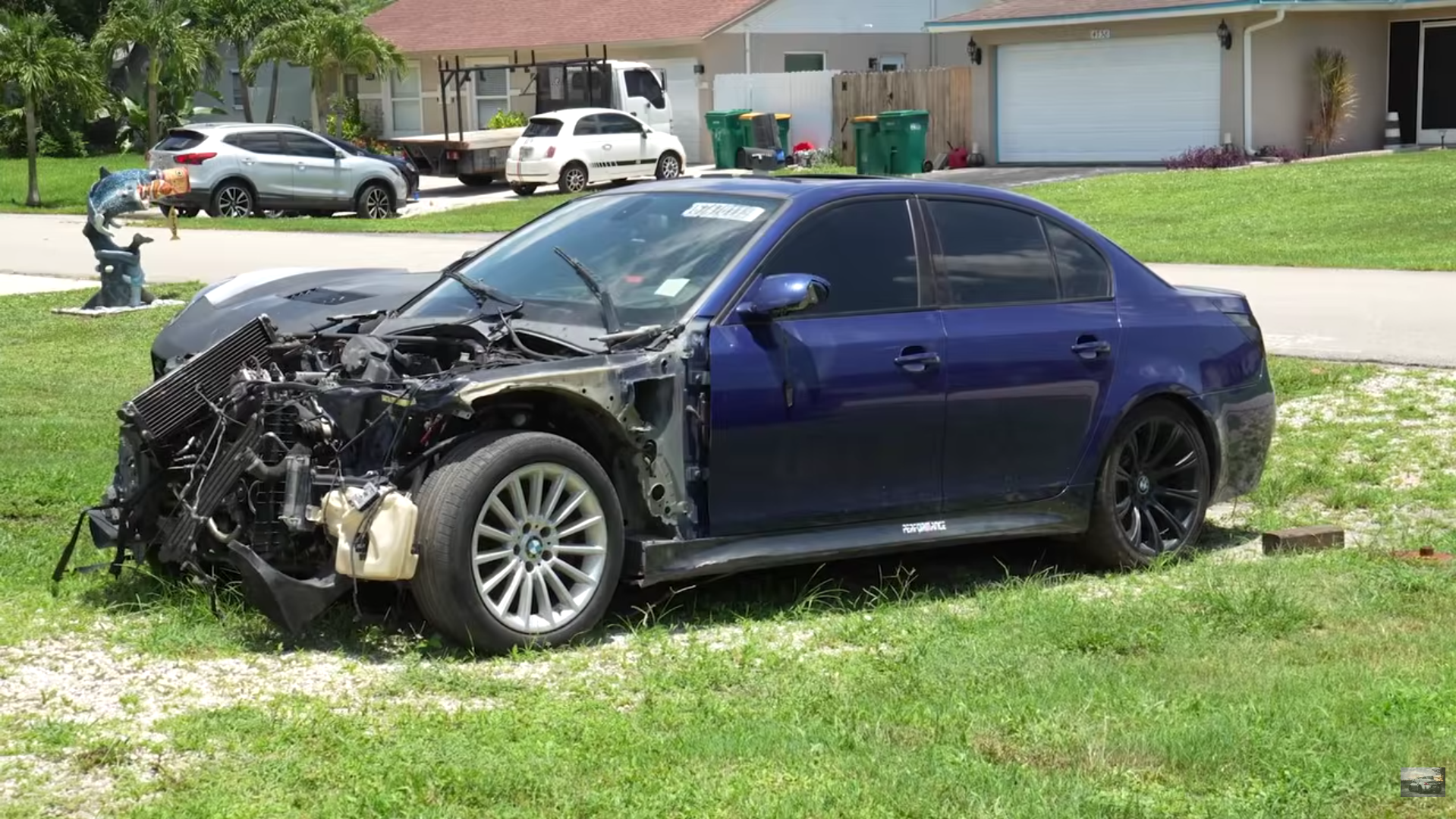
Buying a neglected BMW E60 M5 is already a risky proposition, and doing it sight unseen only raises the stakes. YouTuber Danny Z recently bought an abandoned example with BMW’s legendary V10, hoping to revive it after the car had reportedly spent more than three years sitting inside a repair shop.
The M5 was shipped roughly 1,300 miles from Texas to Florida, where its condition quickly proved worse than expected. It had crash damage, a filthy interior complete with rodent contamination, and a drivetrain that would start but refused to move the car.
Danny had already managed to get the 5.0-liter V10 running again after years of inactivity. The next goal sounded simple enough: repair the damaged front structure, reassemble the car, and drive it for the first time in years.
That plan quickly became a marathon of junkyard hunting, structural repair, diagnosis, and unexpected failures. By the end, the M5 looked far healthier than when it arrived, yet the one thing Danny wanted most still hadn’t happened.
The Front End Was Heavily Damaged
The crash had distorted several aluminum structural sections at the front of the car, including the frame aprons and part of one chassis leg. Replacement pieces were either expensive, difficult to ship, or no longer easy to source for a 2006 car.
Danny found a much cheaper solution at a nearby junkyard, where several regular E60 5 Series models were available for parts. Because many structural pieces are shared across the platform, he cut out usable sections, grabbed a hood, trim, brackets, bolts, and other hardware for just $215.
He estimated that buying equivalent parts separately online could have cost roughly $2,000. The $58 junkyard hood alone was a major win compared with the several hundred dollars he expected to spend elsewhere.
Rebuilding the Structure Wasn’t Straightforward
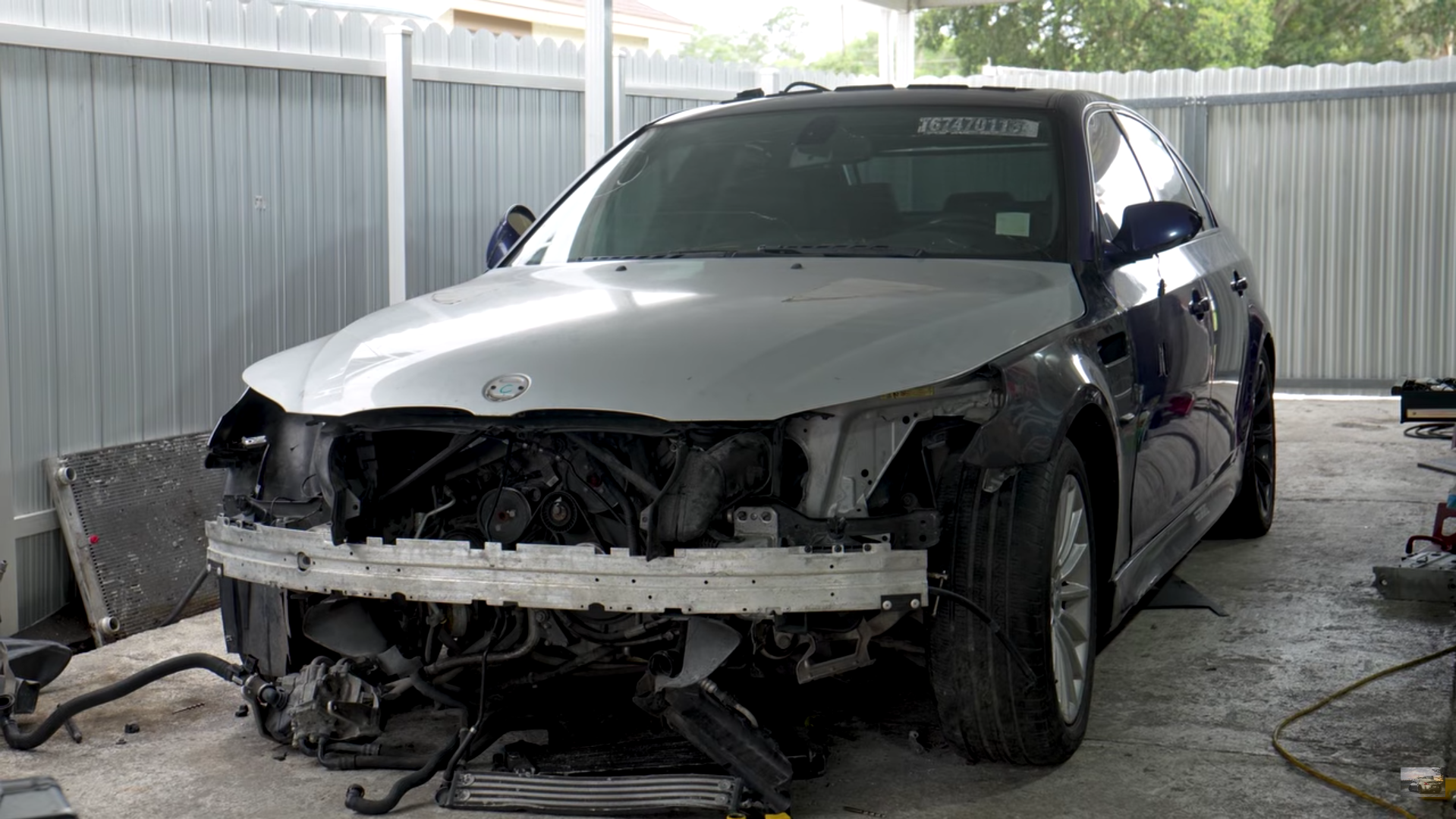
The repair required removing BMW’s factory rivets and separating damaged aluminum panels before the replacement sections could be mocked into place. Danny relied heavily on BMW service information for measurements and repair guidance, while also adapting the procedure to the parts he could actually obtain.
Things became more complicated when one damaged frame section cracked during straightening. Some factory repair plates were no longer readily available, forcing him to rethink how to secure the replacement end section without cutting away otherwise usable structure.
His solution involved BMW-spec structural fasteners, panel-bonding adhesive, and replacement rivets. Before permanently attaching anything, he repeatedly checked factory reference dimensions with a tram gauge and test-fitted the hood, fenders, headlights, and radiator support.
That effort eventually paid off. The radiator stack, body panels, and other front-end components began lining up correctly, giving Danny confidence that the repaired structure was close to where it needed to be.
Then the Air Compressor Nearly Ruined Everything
One of the most stressful moments arrived when it was finally time to bond and rivet one of the replacement panels. The adhesive offered only about an hour of working time, meaning everything had to be positioned, measured, and permanently fastened before the material began curing.
Right when the heavy structural rivets needed to be installed, the shop’s air compressor refused to start. With the clock running, Danny repeatedly tried to revive it before it eventually came back to life.
He managed to install the final rivets just as the working window expired. The opposite side followed afterward, and both replacement panels were eventually bonded and secured.
The V10 Runs, but the M5 Still Won’t Drive
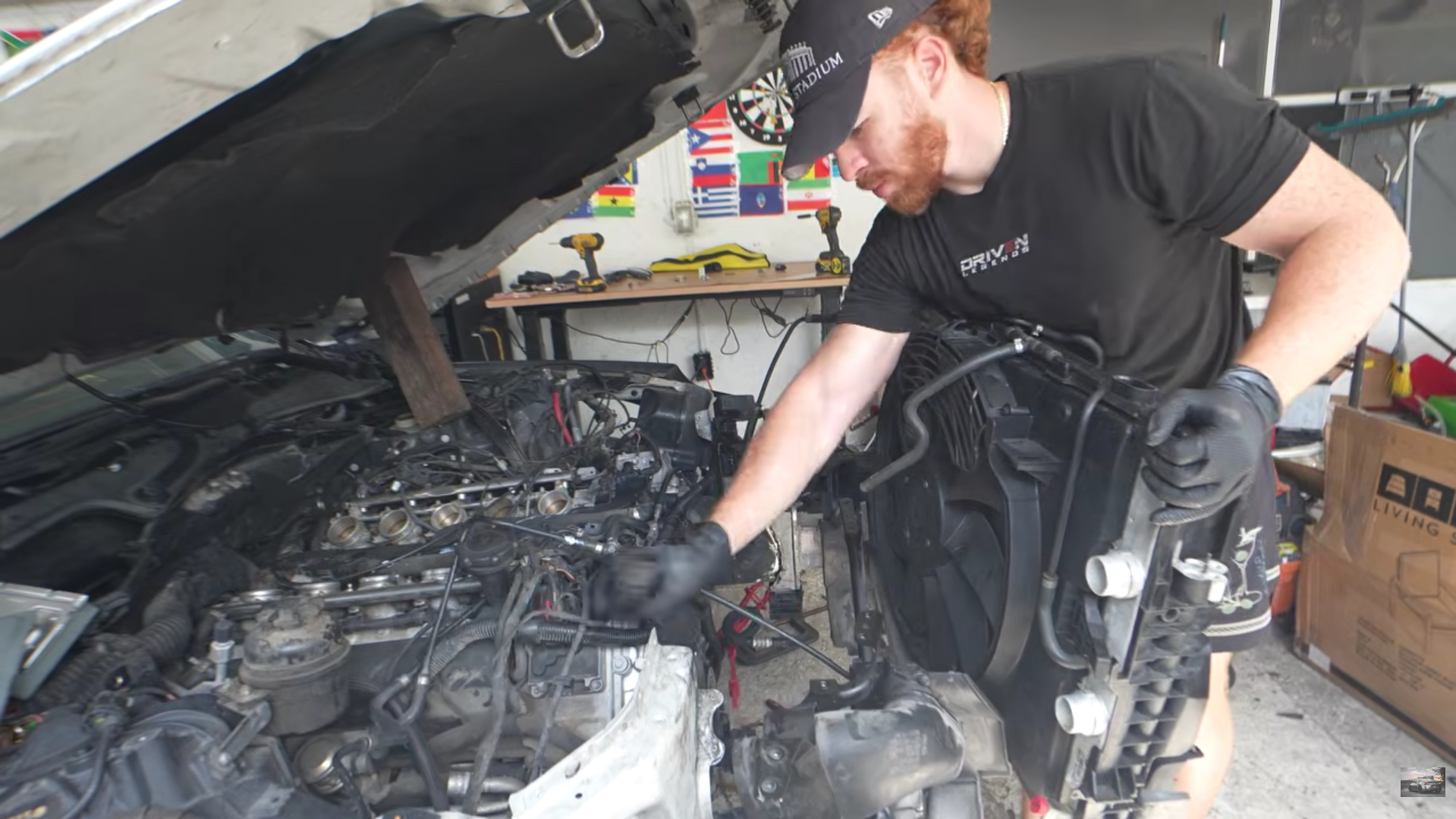
With the front end substantially reassembled, Danny installed a replacement radiator stack and a long-missing V10 intake manifold. Coolant went in without any obvious leaks, and the S85 V10 eventually fired back to life.
The good news did not last long. A scan revealed dozens of stored faults, including idle actuator issues and, more importantly, errors related to the M5’s SMG transmission.
The car could select first gear, but it would not move forward or backward. The fault information suggested that the transmission’s learning procedure had not been completed and that clutch adaptation values could be involved.
Danny attempted to connect BMW’s ISTA diagnostic software, which had helped during the body repair, but the program would not communicate properly with the car. Without access to the necessary SMG learning functions, he was unable to determine whether the issue was purely adaptation-related or something more serious.
The Repair Bill Could Still Get Ugly
The M5 now needs a deeper transmission diagnosis along with additional mechanical work. Danny plans to service the SMG, address leaks, replace fluids, inspect ignition components, and deal with suspected throttle and idle actuator problems.
That list is exactly why rescuing an abandoned E60 M5 can become expensive so quickly. The S85 V10 is spectacular when healthy, but the car surrounding it is complex, and years of neglect can turn every system into another potential repair.
The project did make meaningful progress, with much of the damaged front structure repaired and the engine running once again. Still, after all that cutting, riveting, measuring, sourcing, and reassembly, the M5 remained completely stationary.
For a build centered around finally hearing that V10 pull the car down the road, that was a painful ending. Danny may not regret buying it forever, but after this round of repairs, he certainly had plenty of reasons to question the decision.
Would you ever consider taking on one of BMW’s complex V10 models as a project? Let us know in the comments.