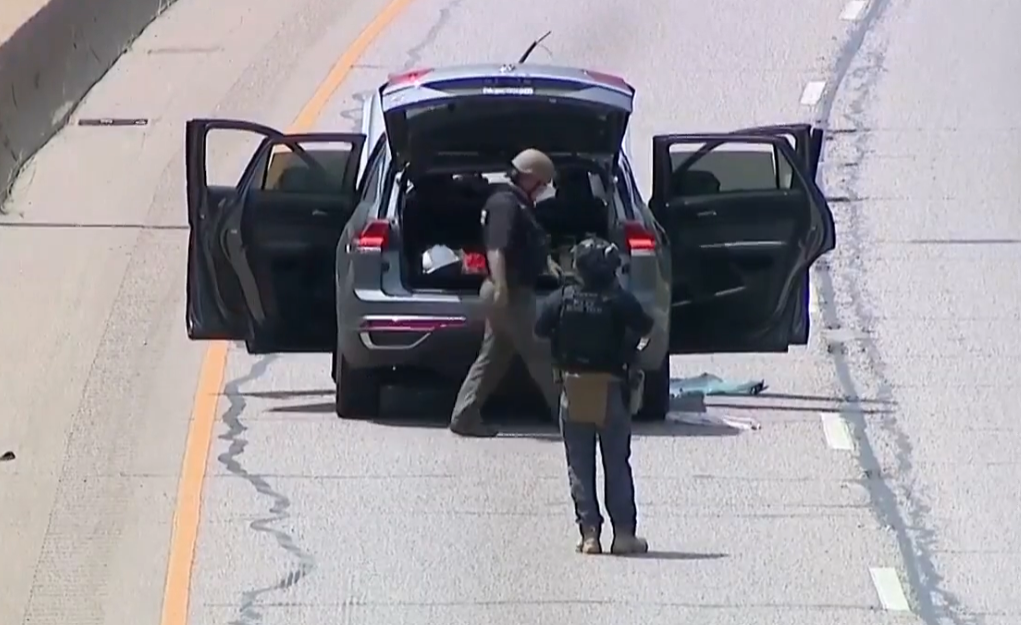
Chicago’s Eisenhower Expressway has seen its share of traffic nightmares over the decades, but what brought I-290 to a complete standstill on June 4, 2026, was unlike anything most drivers had ever encountered. Just after 10 a.m., a Volkswagen Atlas rolled to a stop in the westbound lanes near Mannheim Road after an explosion inside the vehicle. Several windows were blown out, and a man was found dead inside.
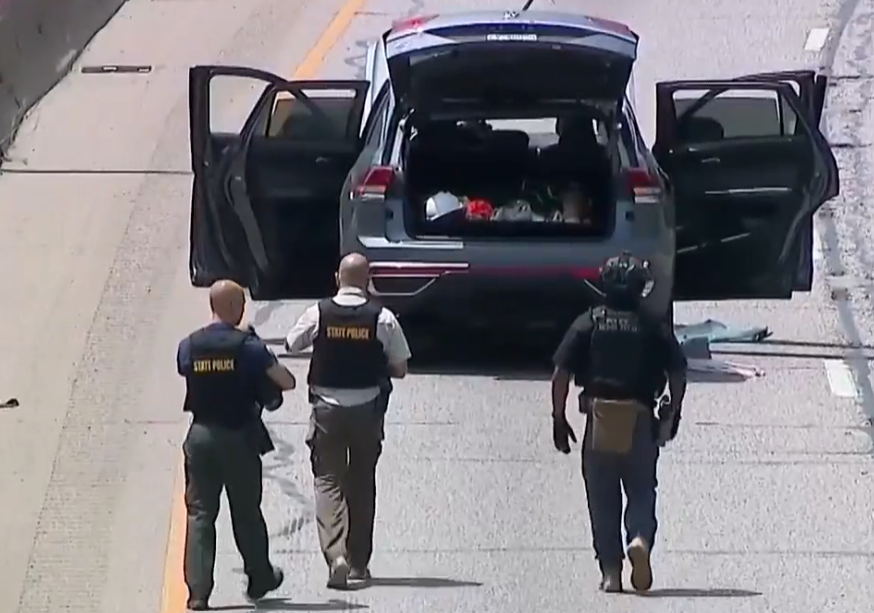
The scene was unusual enough that Illinois State Police quickly requested assistance from specialized investigators, including the Cook County Bomb and Arson Squad, the FBI, the ATF, and the Drug Enforcement Administration.
For nearly eight hours, both directions of the expressway between 25th Avenue and Mannheim Road were shut down entirely. Commuters sat stranded for miles while a white forensic tent was erected around the vehicle and bomb squad technicians worked the scene.
Authorities initially described the situation only as an “active incident,” offering few details while investigators processed the scene. With multiple federal agencies involved and a fatal explosion on one of Chicago’s busiest highways, speculation quickly followed.
Now, thanks to investigative reporting from NBC Chicago, the picture is becoming clearer. A senior law enforcement official with direct knowledge of the case told NBC 5 that the explosion was caused by a commercial-grade firework mortar that ignited inside the driver’s compartment of the SUV.
The firework shell reportedly struck 47-year-old Jorge Vaca of Cicero in the chest, killing him. Authorities say it was not a planted bomb and that no other individuals were involved, though investigators have not publicly explained where the mortar was positioned inside the SUV or what caused it to ignite. The blast damaged the SUV and blew out several of its windows, but remarkably, no one else on the expressway was injured.
The remaining question is whether any of this was intentional.
Investigators initially examined the possibility that Vaca had been targeted because of prior contact with the DEA, but that theory was ruled out early. As of the latest reporting, a senior federal official told NBC Chicago that investigators are leaning toward the possibility of suicide, though the Cook County Medical Examiner has not yet ruled on the manner of death.
A Commercial-Grade Firework, Inside a Moving SUV
Commercial-grade firework mortars are a different animal from the consumer stuff sold at roadside tents every Fourth of July. These are the devices used in professional fireworks displays, firing shells high into the air before they burst overhead. They are not designed to be operated indoors, in enclosed spaces, or inside the cab of a moving vehicle at highway speed.
When a mortar of this type ignites in an enclosed space, the result can be catastrophic. The shell has nowhere to safely travel. In Vaca’s case, according to law enforcement sources, it went directly into his chest.
The force of the blast was sufficient to damage the Atlas and bring one of the busiest corridors in the Chicago metro area to a complete stop.
Eight Hours, Dozens of Agencies, and Almost No Information
What made the June 4 incident particularly striking was the sheer scale of the law enforcement response relative to what authorities were willing to say publicly.
The FBI and ATF led the investigation, with support from Illinois State Police, the Cook County Bomb and Arson Squad, and the DEA. A joint federal statement issued the following day confirmed only that an explosion had caused a single fatality and that the incident did not appear connected to any other events.
Federal officials said specialized resources were necessary to safely process the scene and ensure public safety. That was about as far as officials were willing to go publicly.
When WGN reached out to the DEA specifically to ask whether Vaca had been under investigation by their agency, a spokesperson replied only that the DEA does not disclose information regarding the existence, status, or details of potential or ongoing investigations. The agency declined to provide additional details.
The DEA Connection and the Cartel Question
The DEA’s involvement at the scene and the early revelation that Vaca had reportedly had prior contact with the agency sent the first round of speculation in a very specific direction. When a man with ties to federal drug enforcement dies in an explosion on a Chicago expressway, the word “cartel” is not far behind. Multiple senior law enforcement sources initially told NBC Chicago that investigators had not ruled out the possibility that Vaca had been deliberately targeted.
Sources told NBC Chicago that investigators ruled out the possibility that Vaca had been targeted early in the investigation.
Retired DEA Assistant Special Agent in Charge Mike Gannon, reflecting on the incident, put it plainly: the relief was that the explosion was contained within the vehicle. Had the blast been external, the potential for civilian casualties on a crowded expressway would have been substantial.
What Happens Next
The Cook County Medical Examiner’s Office has identified Vaca as the victim but has not yet released an official cause or manner of death. That determination remains the critical outstanding piece of the investigation.
Illinois law places strict limits on the sale of professional-grade fireworks to individuals without proper licensing, but enforcement of those statutes at the point of acquisition has historically been inconsistent. The presence of a commercial mortar inside a civilian vehicle on a public highway raises questions that extend well beyond this one incident.
For now, investigators are working toward a final determination in a case that remains full of unanswered questions.