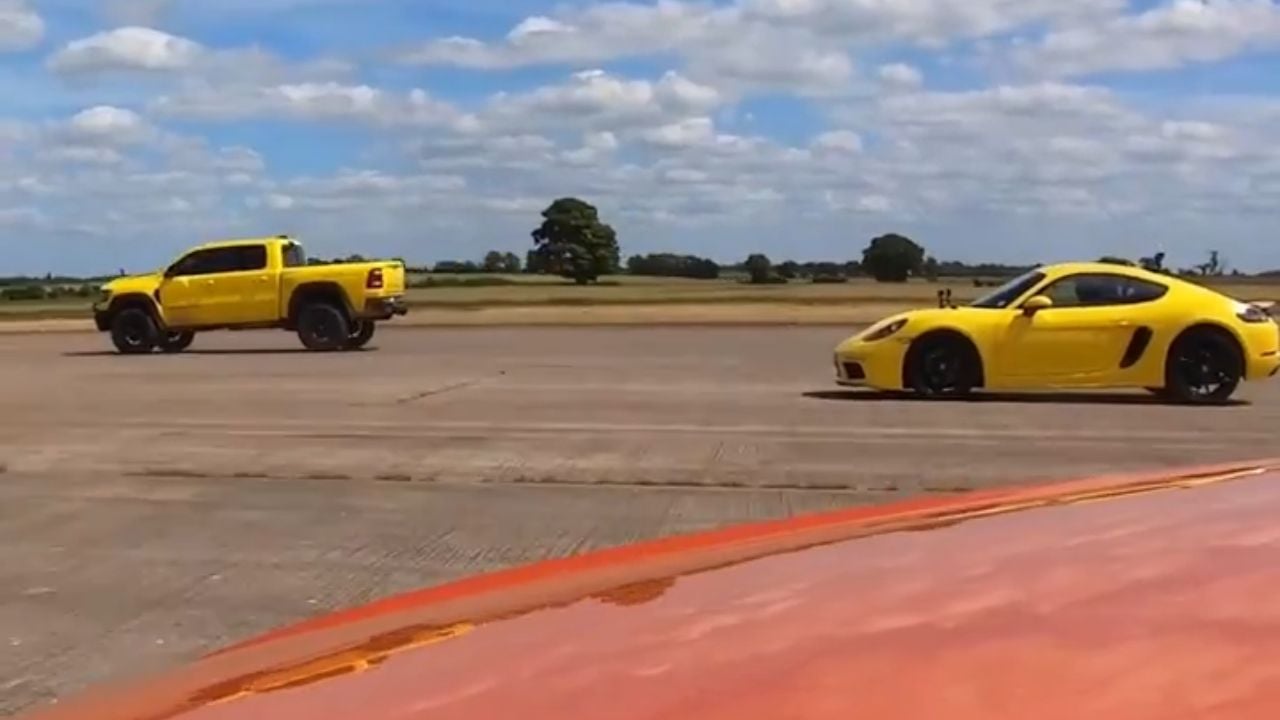

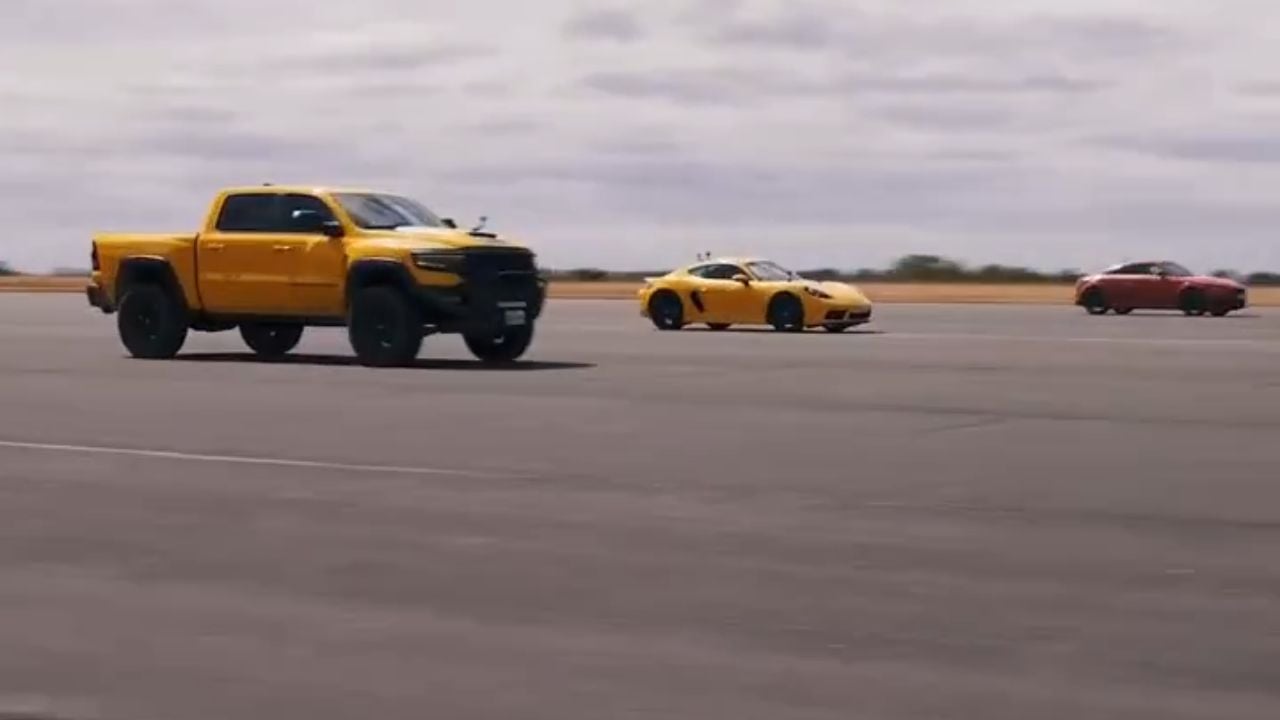
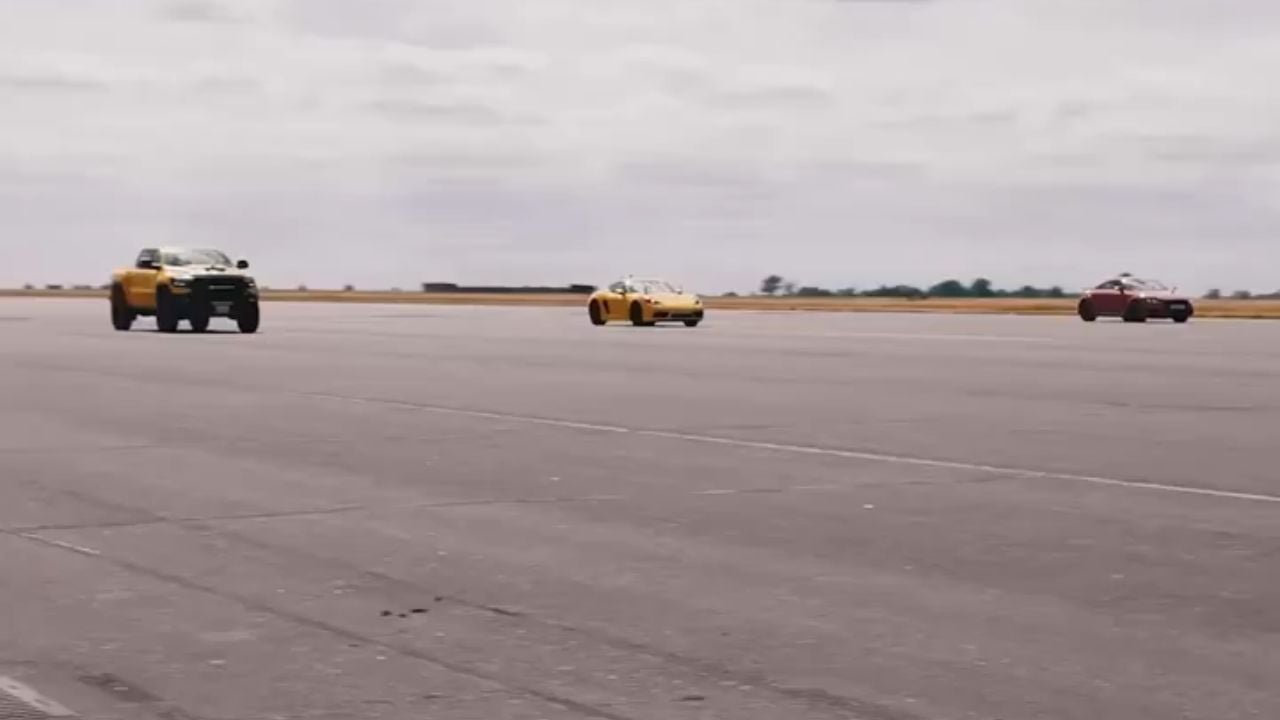
Last week, automotive content powerhouse Carwow UK dropped a brief but curiously geeky experiment on X: a braking test comparing a truck (Hennessey Mammoth 1000 TRX) and sports cars (Porsche 911 and Nissan Z), with results that may have stopped the internet in its tracks.
The post simply read “TESTED: The difference between a truck and sports car when braking!” with footage showing the three vehicles stopping from speed, yet the truck seemed to perform unusually well. That got some serious eyebrows raised.
At first glance, and without the nitty-gritty, this looks like a simple drag-race-meets-brake-test clip. But automotive physics and brake system mechanics tell a much richer story behind what’s really going on.
Trucks Don’t Always Stop Last
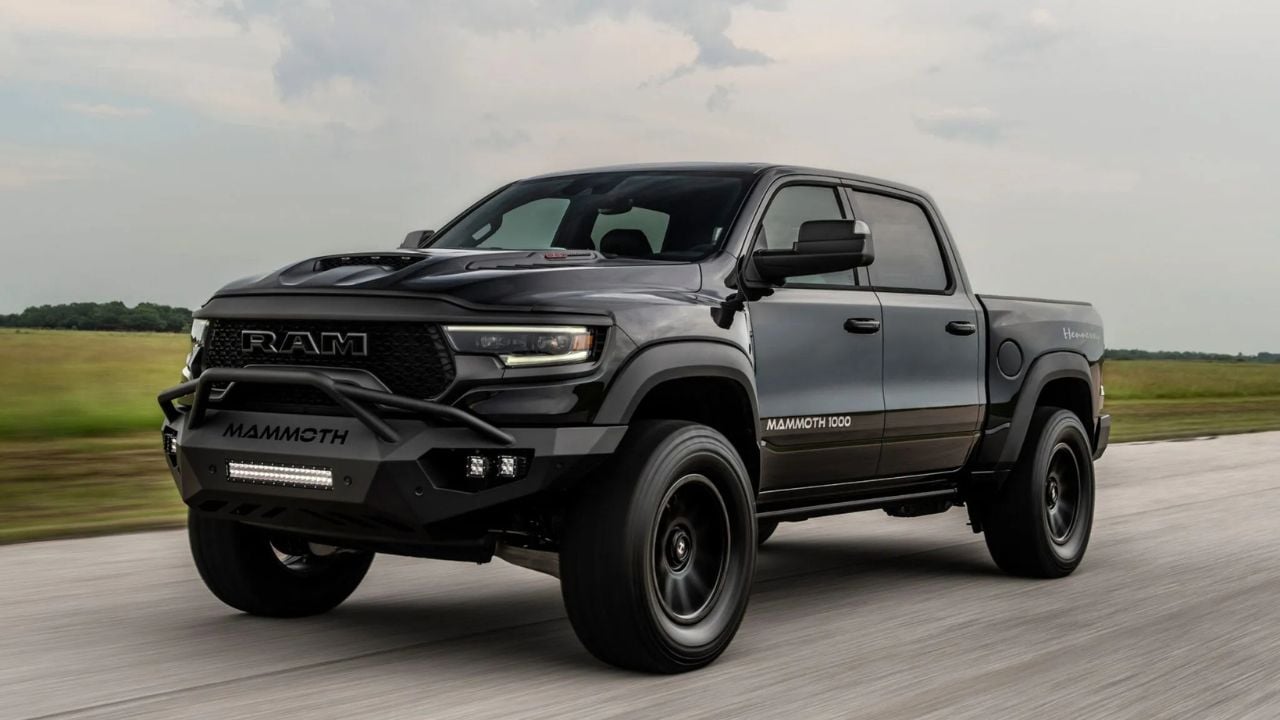
On paper, a heavy truck should almost never out-brake a lightweight sports car. After all, braking performance is fundamentally tied to dissipating kinetic energy, which scales with ½ × mass × velocity². A truck has far more energy to dissipate due to its high mass, and while big brakes help, they don’t change that basic math.
But real-world braking doesn’t completely hang on physics textbooks but also about how that energy gets handled. Modern vehicles use disc brakes with sophisticated ABS (Anti-Lock Braking Systems) that dynamically modulate brake force to keep tires on the edge of maximum grip.
Good tires often matter more than big brake discs: if the tires can’t maintain friction, all the braking power in the world is wasted. You see, tires are the single biggest, least-obvious factor in this little physics experiment of tires, suspension geometry, brake architecture, and electronic calibration.
The Mammoth 1000 TRX runs massive, ultra-wide off-road tires (often 325–35 cm wide depending on spec). Even though they’re all-terrain rather than semi-slicks, the sheer contact patch area is enormous. Under heavy braking, tire friction (not brake size) is the hard limit, and friction force scales with normal load.
Alright, let’s slow this right down and really chew through it, because this result only makes sense once you see how many small, unglamorous engineering decisions stacked up in the TRX’s favor.
Big Brakes Don’t Stop Cars
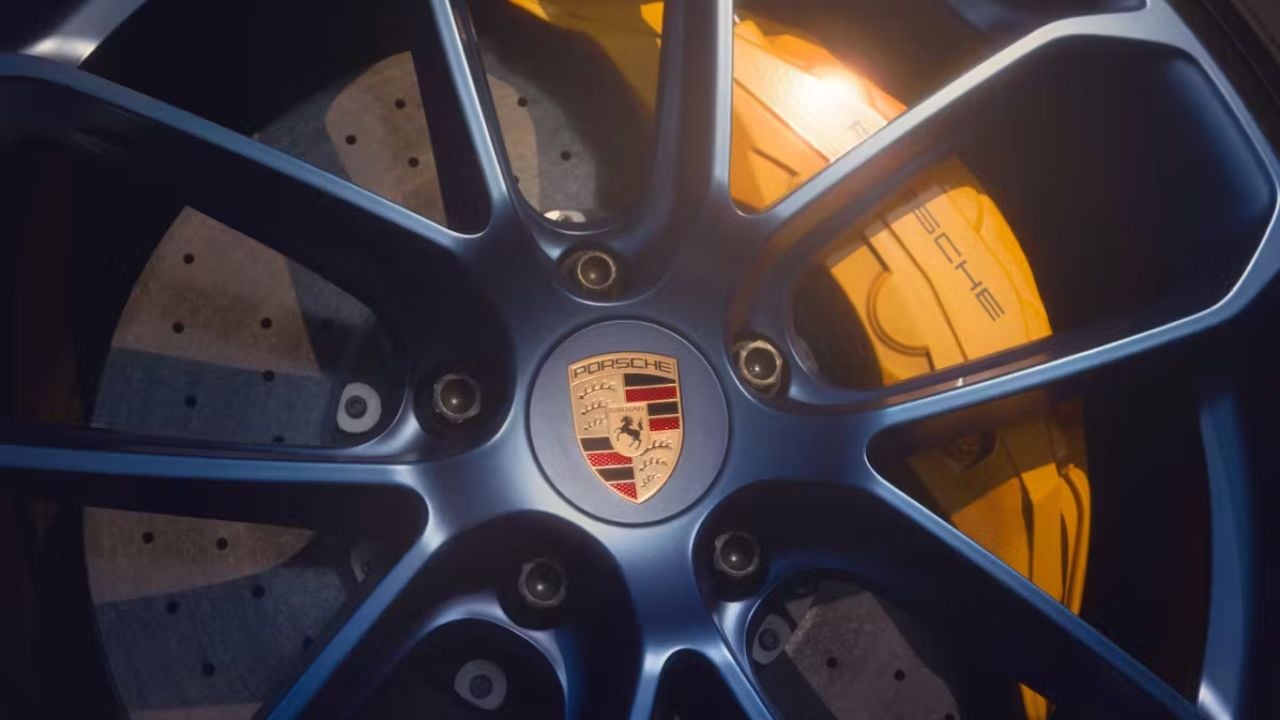
At the heart of the misunderstanding is the idea that braking performance is dictated primarily by brake hardware. Big discs, fancy calipers, carbon ceramics — therefore short stopping distances.
In reality, brakes don’t stop cars; tires do. Brakes only convert kinetic energy into heat, and the tires decide how much of that braking force can actually be transmitted into the road surface before grip is lost. Once that friction limit is reached, additional braking force achieves nothing except ABS intervention.
That’s where the Hennessey Mammoth 1000 TRX starts quietly rewriting expectations. The truck is brutally heavy, yes, but that mass also generates an enormous normal force at the tire contact patches during braking. Its wide tires are also tall, compliant, and designed to deform.
When those tires are loaded under heavy deceleration, the sidewalls flex and spread the contact patch across imperfect asphalt, increasing mechanical keying into the road surface. On real-world tarmac (which is never perfectly smooth) this kind of compliance can produce more usable braking grip than the ultra-stiff, low-profile performance tires fitted to sports cars.
By contrast, the Porsche 911 and Nissan Z rely on tires optimized for lateral grip, steering precision, and high-speed stability. These tires are incredible on a clean circuit and under controlled conditions, but they are far more sensitive to surface quality.
Their stiff sidewalls resist deformation, which improves turn-in but reduces their ability to conform to micro-textures in the road during hard, straight-line braking. In a panic stop, that difference matters more than people expect.
Heavy Metal vs. Fine Art
The brake systems themselves tell a similar story. The Porsche 911’s braking hardware is engineering art, especially when equipped with ceramic composite discs. Those brakes are designed to resist fade under repeated high-energy stops and to deliver consistent pedal feel at extreme temperatures.
But ceramics don’t deliver their best bite when cold or semi-cold, and they rely heavily on precise ABS modulation to stay within the tire’s grip envelope. In a single, abrupt braking test rather than a series of high-temperature laps, they’re not operating in their ideal window.
The TRX, on the other hand, uses vast steel rotors with immense thermal mass and huge mechanical leverage thanks to its wheel diameter. The braking torque available at the hub is enormous, not because the truck is trying to be sporty, but because it must be able to repeatedly stop a vehicle weighing over three tons while towing, descending grades, or operating off-road.
There is nothing delicate about the system; it’s designed to apply huge clamping force confidently and predictably from the first pedal press.
ABS calibration then becomes the real star of the show. Modern ABS is not a generic safety system; it’s deeply tailored to each vehicle’s mass, suspension behavior, tire characteristics, and intended use. The TRX’s ABS is tuned for instability as a default assumption.
It expects uneven surfaces, deforming tires, massive weight transfer, and sudden load shifts. As a result, it allows extremely high brake pressures while keeping each wheel just shy of lock-up, even as the tires squash and rebound beneath the chassis.
Sports cars like the 911 are calibrated differently. The goal isn’t maximum straight-line deceleration at all costs; it’s maintaining directional stability and driver control at very high speeds. The 911’s rear-engine layout complicates this further.
Under hard braking, weight shifts forward rapidly, but a significant portion of mass remains over the rear axle. As the front tires approach their grip limit, ABS intervenes early to prevent lock-up and maintain steering authority. That intervention can slightly extend stopping distances, even though the car feels composed and controlled throughout the stop.
Why the “Worst” Truck Was Actually the Best Stopper
Suspension design quietly reinforces all of this. The TRX’s long-travel suspension allows controlled dive under braking, which actually helps load the front tires progressively rather than abruptly. That smooth load transfer keeps the contact patches stable and maximizes friction.
The sports cars, by comparison, run stiff suspension to maintain chassis control, aero balance, and responsiveness. That stiffness reduces compliance, and on anything less than perfect asphalt, compliance is what keeps tires hooked up under heavy braking.
The Nissan Z sits in an awkward middle ground. It’s heavier than it looks, more grand tourer than track weapon, and its braking system is designed for balanced performance rather than extremes. It lacks the truck’s brute-force grip and the Porsche’s motorsport-derived finesse, and that leaves it vulnerable in this kind of real-world head-to-head.
Put all of this together and the result stops being surprising. The Mammoth 1000 TRX didn’t disappoint physics; it exploited every part of it that favors mass, tire compliance, conservative electronics, and suspension travel. The Porsche 911 and Nissan Z didn’t perform miracles; they simply revealed that the assumptions we make about braking are shaped more by spec sheets than by how cars actually interact with real roads.
That’s the uncomfortable truth hidden in this clip: when conditions are uncontrolled and the surface is imperfect, the vehicle engineered for worst-case scenarios often wins.
Why the Result Caught Attention
The Carwow post was short on context, and many in the replies correctly pointed out that measuring braking performance by eye — or by simplistic comparison — is not straightforward. A common theme from automotive forums and track-day communities is that tires, road surface, and brake setup determine real stopping performance far more than mass alone.
TESTED: The difference between a truck and sports car when braking! pic.twitter.com/qLWTytVCI6
— carwow (@carwowuk) January 8, 2026
One Reddit commenter explained that wider, stickier tires can make a huge difference, while ABS systems maintain control rather than simply stop the car, Meaning, two cars with very different hardware can post surprisingly close braking distances under the right conditions.
Others noted that typical media-style brake tests don’t account for factors used in official stopping-distance standards (like reaction time, consistent measurement techniques, or calibrated data loggers), so viral vids should be taken as entertaining, not definitive.
The bottom line is that Carwow’s snippet was, at its heart, a fun little car-geek moment — but under the hood, it highlights how complex braking really is. When trucks and sports cars square off like this, it should be about how each machine manages energy, tire grip, and mechanical limits. Anyone reading this test with a bit of technical insight will walk away with a deeper respect for brake system mechanics, not just the stop-watch numbers.